Expert Analysis

Medical Device Reviews

Evidence-based evaluations to help you make informed decisions

Vitalograph Lung Monitor

Peak Flow Meters

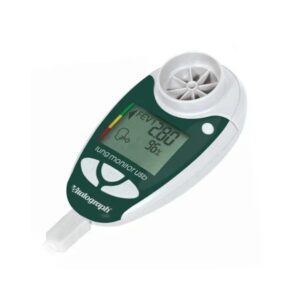
Vitalograph Lung Monitor Review: Comprehensive Respiratory Tracking for Chronic Conditions

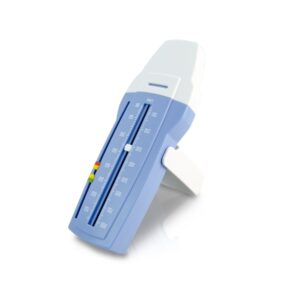
The Vitalograph Lung Monitor is an advanced electronic device engineered for the home monitoring of chronic respiratory conditions such as COPD, cystic fibrosis, and for post-transplant patient care. Classified as a Class II medical device, it stands out by measuring a broader range of clinical parameters than basic peak flow meters, specifically Peak Expiratory Flow (PEF), Forced Expiratory Volume in 1 second (FEV1), and Forced Expiratory Volume in 6 seconds (FEV6). The inclusion of FEV6 is a significant engineering feature, as it provides a reliable surrogate for Forced Vital Capacity (FVC) in home settings, allowing for the calculation of the FEV1/FEV6 ratio to identify obstructive patterns. The device features an internal memory capable of storing 200 sets of readings, allowing for detailed longitudinal analysis. Our clinical evaluation highlights the device's adherence to American Thoracic Society (ATS) and European Respiratory Society (ERS) standards. It includes a traffic light risk indicator system based on the user's personal best, providing immediate feedback on lung function status. While highly accurate, the basic model is a standalone unit, with connectivity reserved for higher-tier variants in the series.
$324
Vitalograph asma-1 Asthma Monitor

Peak Flow Meters

Vitalograph asma-1 Asthma Monitor Review: Clinical-Grade Monitoring with Extensive Data Storage

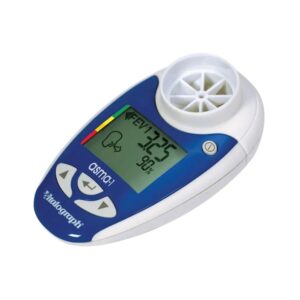
The Vitalograph asma-1 is a sophisticated electronic monitor designed for objective lung function testing in both home and clinical settings. As a Class II medical device, it measures both Peak Expiratory Flow (PEF) and Forced Expiratory Volume in one second (FEV1), allowing for a more nuanced clinical assessment of airway obstruction than basic peak flow meters. A primary engineering advantage of the asma-1 is its massive internal memory, which stores up to 600 sets of readings-far exceeding the standard 240 readings found in many competing digital monitors. The device features integrated quality prompts to ensure valid maneuvers and a customizable 'traffic light' system for immediate zone assessment relative to the user's personal best. The sensor technology is designed to meet or exceed rigorous international standards for spirometry, including ATS and ERS guidelines. While primarily a standalone electronic tool, its high-capacity logging and ability to generate detailed clinical reports make it a cornerstone of 2026 respiratory management for chronic patients.

$99
Omron Peak Air Peak Flow Meter (PF9940)

Peak Flow Meters

Omron Peak Air Peak Flow Meter (PF9940) Review: Simple, Reliable Home Monitoring

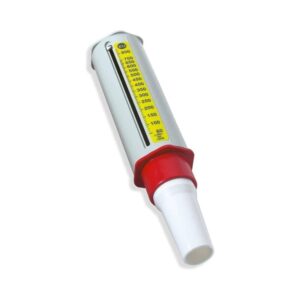
The Omron Peak Air (PF9940) is a mechanical, Class II medical device designed for the domiciliary monitoring of Peak Expiratory Flow (PEF). It features a universal range of 60 to 720 L/min, which is specifically engineered to accommodate both pediatric and adult populations within a single device. The unit operates on a time-tested spring-and-piston mechanism that captures the maximum velocity of air during a forced exhalation maneuver. Our technical assessment indicates that the device meets standard technical requirements for accuracy and repeatability for home monitoring. The design is lightweight and reusable, featuring a sliding indicator that holds the measurement until manually reset. While the 720 L/min upper limit may be slightly restrictive for very high-flow adult males or athletes, it provides sufficient range for the vast majority of asthma and COPD patients. The device includes adjustable color-coded markers for manual zone management, assisting users in following their personalized asthma action plans.

$30
Quest AsthmaMD BreatheWell Lung Performance Peak Flow Meter

Peak Flow Meters

Quest AsthmaMD BreatheWell Lung Performance Peak Flow Meter Review: Integrated App-Based Asthma Management

The Quest AsthmaMD BreatheWell represents a strategic integration of reliable mechanical sensing with modern digital data management. Classified as a Class II medical device under 21 CFR 868.1860, this handheld monitor is engineered for the domiciliary assessment of Peak Expiratory Flow (PEF). Our evaluation confirms that while the device itself is a purely mechanical, spring-loaded piston system, its primary innovation lies in its pairing with a robust, physician-developed smartphone application. The meter features easy-to-read graduations and adjustable three-zone markers that allow users to delineate green, yellow, and red zones based on their personal best values. Technical specifications highlight its portability and durability, with dimensions of 6 x 2.25 x 1.5 inches. Clinical feedback indicates the device is among the most accurate in the mechanical class, specifically designed to capture the high-velocity 'fast blast' of air required for objective lung function measurement. The AsthmaMD app facilitates better adherence by replacing paper journals with automated trending and reporting features, though it requires users to manually input the values read from the physical device.

$20
Micro Direct MicroPeak

Peak Flow Meters

Micro Direct MicroPeak Review: Gold-Standard Mechanical Reliability

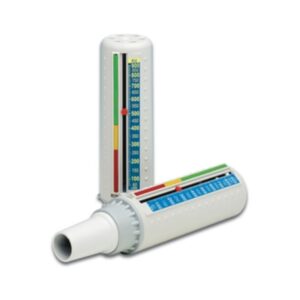
The Micro Direct MicroPeak is a professional-grade mechanical peak flow meter designed to meet the rigorous performance requirements of both the American Thoracic Society (ATS) and European standards (EN13826). Manufactured by Micro Medical Ltd and fabricated by Fyne Dynamics, it utilizes a precision-calibrated internal spring and piston mechanism. A standout engineering feature is the in-built internal check valve, which ensures that air can only be expired into the device, effectively preventing cross-infection-a critical safety feature in multi-patient clinical environments. The device features a large, high-visibility scale that provides clear resolution from 60 to 900 L/min, making it suitable for a broad spectrum of patients from pediatrics to high-flow athletes. Clinical performance data indicates that the device maintains an accuracy of within +/- 5% to 10%, depending on the specific scale used, with exceptional longitudinal repeatability. The inclusion of movable asthma management color zones that do not wash off further enhances its utility for daily patient self-management.

$25
DynamiTech DynamiPeak Peak Flow Meter

Peak Flow Meters

DynamiTech DynamiPeak Review: High-Resolution Mechanical Monitoring

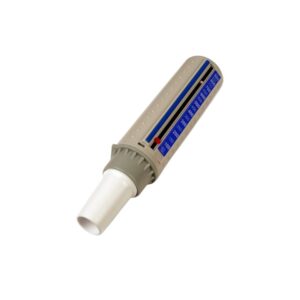
The DynamiTech DynamiPeak Peak Flow Meter is a mechanical monitoring device designed to measure Peak Expiratory Flow Rate (PEFR) for both pediatric and adult subjects. Manufactured by Fyne Dynamics, Ltd., it distinguishes itself from entry-level mechanical meters through its advanced engineering and material choices. The device employs an internal piston and stainless steel spring mechanism. As exhalation begins, the piston extends the spring in response to the internal pressure spike, pushing a sliding indicator to the maximum displacement position. A critical engineering feature is the displacement function, which is logarithmic; this provides significantly greater resolution at the lower end of the scale, allowing for more precise tracking of small changes in lung function for children or patients with severe obstruction. The unit is constructed from high-quality medical-grade polymers and stainless steel for durability and longitudinal accuracy. Our evaluation confirms the device meets all American Thoracic Society (ATS) standardization recommendations and is factory-calibrated for every individual unit.

$28
Clement Clarke Mini-Wright Digital

Peak Flow Meters

Clement Clarke Mini-Wright Digital Review: Rugged, Waterproof Accuracy

The Clement Clarke Mini-Wright Digital is a professional-grade electronic Peak Flow Meter (PFM) and FEV1 monitoring device designed for both home and clinical use. Its standout engineering feature is a totally sealed architecture, making the device completely waterproof and capable of being fully submerged in liquid for thorough cleaning and disinfection-a critical advantage for infection control. Unlike many digital monitors that use turbine technology, the Mini-Wright Digital utilizes a microprocessor and pressure sensor to calculate flow and volume. Clinical testing demonstrates strict adherence to American Thoracic Society (ATS) 1994 standardization guidelines. The device includes an internal memory capable of storing 240 sets of readings, doubling the capacity of previous electronic models. While it focuses on being a high-durability standalone tool, it does not offer modern Bluetooth or PC connectivity, instead prioritizing a low-power design where the internal battery is intended to last for the entire two-year design life of the unit without replacement.

$220
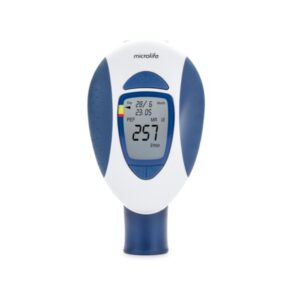
Microlife Digital Peak Flow Meter (PF-100)

Peak Flow Meters

Microlife Digital Peak Flow Meter (PF-100) Review: Reliable Clinical Precision with Standalone Utility

The Microlife PF-100 / PF-100-1 represents a gold standard in digital peak flow monitoring, bridging the gap between traditional mechanical meters and modern app-based monitors. As an FDA-cleared Class II medical device, it is unique for offering an integrated LCD display that provides immediate readings for both Peak Expiratory Flow (PEF) and Forced Expiratory Volume in one second (FEV1), eliminating the mandatory reliance on a smartphone. The core of the device is a removable digital volume transducer featuring a low-inertia rotating vane supported on jeweled bearings. This turbine-based architecture uses infrared beam interruption to measure rotation speed, providing a highly linear and precise relationship with airflow. Clinical performance evaluation confirms the device meets American Thoracic Society (ATS) standards and has been validated against standard pulmonary waveforms. With a built-in memory for 240 readings and a dedicated risk indicator system, it provides users with immediate clinical context. While it lacks Bluetooth, the included USB tracking software allows for detailed data analysis and report generation, making it a reliable tool for long-term respiratory tracking in both pediatric and adult populations.

$60
MIR Smart One

Peak Flow Meters

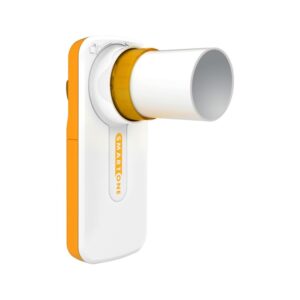
MIR Smart One Review: Professional-Grade Digital Monitoring for the Home

The MIR Smart One marks a significant shift from traditional mechanical peak flow meters to digital, app-driven respiratory care. Manufactured by Medical International Research (MIR), a leader in clinical spirometry, this device utilizes a bi-directional digital turbine sensor-the same technology found in professional pulmonary function labs. This sensor architecture effectively eliminates the mechanical fatigue and friction issues associated with spring-based meters. The device measures two critical parameters: Peak Expiratory Flow (PEF) and Forced Expiratory Volume in one second (FEV1), offering a deeper level of insight into airway obstruction than a standard PFM. In clinical evaluations and bench testing, the Smart One demonstrated high concordance with laboratory-grade equipment, meeting the rigorous ATS/ERS 2019 standards. The companion mobile app provides real-time testing animations to ensure proper technique and uses a 'traffic light' system to categorize results based on user-specific predicted values. While the hardware is exceptionally robust, the user experience is heavily dependent on the mobile app, which has faced some criticism for UI inconsistencies and data management limitations.

$139
Safey Connected Peak Flow Meter

Peak Flow Meters

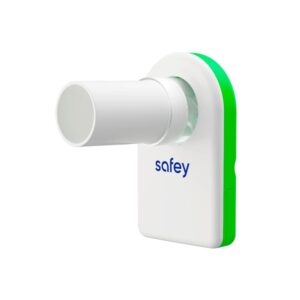
Safey Connected Peak Flow Meter Review: Advanced Smart Monitoring for Asthma and COPD

The Safey Connected Peak Flow Meter represents a significant advancement over traditional mechanical devices by integrating a high-precision turbine sensor with mobile connectivity. As an FDA-cleared Class II medical device, it measures both Peak Expiratory Flow (PEF) and Forced Expiratory Volume in one second (FEV1), providing a more comprehensive view of lung function than standard meters. Our evaluation focused on the device's technical architecture, specifically its use of the infrared interrupt concept. This design uses a vane that rotates based on airflow, with infrared pairs detecting rotation speed and direction to calculate results. This method significantly reduces the friction-related errors often seen in mechanical spring-based systems. Clinical performance data demonstrates that the device adheres strictly to American Thoracic Society (ATS) and European Respiratory Society (ERS) standards for spirometry. The companion mobile application automatically categorizes results into standardized green, yellow, and red zones, simplifying the implementation of asthma action plans. The build quality is robust, featuring medical-grade polymers and an IP22 ingress protection rating, making it suitable for both home and clinical environments.

$99

How We Test

Our reviews combine real-world testing, clinical evidence analysis, and medical professional input to provide comprehensive evaluations you can trust.

Clinical Standards

ISO methodology and evidence-based evaluation criteria

Medical Review

Healthcare professionals validate our findings

Real-World Testing

Extended use periods for authentic insights

Want to Compare Devices Yourself?

Create your own custom 1v1 comparison! Select any 2 devices from the same category to see detailed side-by-side performance, features, and clinical evidence.