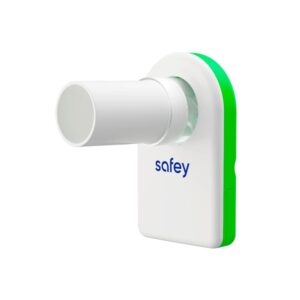
The MIR Smart One is a high-precision digital monitor that leverages clinical-grade turbine technology to provide reliable longitudinal tracking for asthma and COPD patients.
MIR Smart One Review: Professional-Grade Digital Monitoring for the Home
The MIR Smart One marks a significant shift from traditional mechanical peak flow meters to digital, app-driven respiratory care. Manufactured by Medical International Research (MIR), a leader in clinical spirometry, this device utilizes a bi-directional digital turbine sensor-the same technology found in professional pulmonary function labs. This sensor architecture effectively eliminates the mechanical fatigue and friction issues associated with spring-based meters. The device measures two critical parameters: Peak Expiratory Flow (PEF) and Forced Expiratory Volume in one second (FEV1), offering a deeper level of insight into airway obstruction than a standard PFM. In clinical evaluations and bench testing, the Smart One demonstrated high concordance with laboratory-grade equipment, meeting the rigorous ATS/ERS 2019 standards. The companion mobile app provides real-time testing animations to ensure proper technique and uses a 'traffic light' system to categorize results based on user-specific predicted values. While the hardware is exceptionally robust, the user experience is heavily dependent on the mobile app, which has faced some criticism for UI inconsistencies and data management limitations.
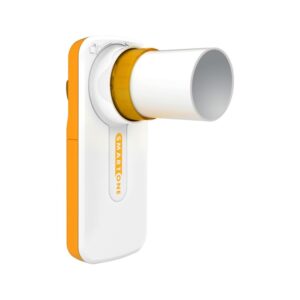
Table of Contents
Clinical Summary
Clinical Performance Metrics
Quantitative assessment based on clinical testing protocols
Measurement Accuracy
Features a clinical-grade turbine sensor with a volume accuracy of ±2.5% or 0.05 L, matching the precision of professional office spirometers.
Ease of Use
Hardware setup is a simple 'pair and play' process, but the app-centric design may present challenges for users who are less comfortable with smartphone interfaces.
Build Quality
Extremely durable medical-grade construction with a turbine rated for thousands of tests; the unit is compact, lightweight, and rated for continuous professional-grade use.
Value for Money
Positioned at a premium price point, but the inclusion of FEV1 measurement and lab-quality sensing justify the investment for long-term chronic disease management.
Quick Take
Key findings from our clinical evaluation
+
Strengths
- Uses laboratory-grade digital turbine technology for superior accuracy.
- Measures both FEV1 and PEF for more comprehensive clinical data.
- Extremely long battery life with standby up to 10 years on two AAA batteries.
- Seamless integration with Apple Health for unified data viewing.
- Provides real-time feedback animations to help users perform tests correctly.
−
Limitations
- No on-board display; requires a smartphone to see any results.
- Mobile application has experienced UI bugs on newer smartphone operating systems.
- Higher upfront cost than most other over-the-counter peak flow meters.
Real-World Usage
Practical considerations for daily operation
Daily Routine Impact
The device's small footprint and fast test time make it easy to incorporate into a morning and evening routine. Results are instantly logged, eliminating the need for paper journals.
Learning Curve
Master in an hour
Maintenance
Periodic cleaning of the turbine and mouthpiece using a standard water/bleach solution (1:20 ratio) for disinfection.
Portability
Highly portable; the device weighs only 60.7 grams and is specifically designed for 'professional lung care in your pocket'.
Manual Use
Cannot be used manually as there is no built-in screen or data storage on the device itself; all data is held in the smartphone app.
Cost & Coverage Analysis
Financial considerations and HSA / FSA eligibility
Pricing Breakdown
HSA/FSA Guidance
Qualifies as DME under category BZH; often eligible for HSA/FSA reimbursement. Check with your insurance provider for specific plan coverage.
Cost Comparison
Significantly more expensive than mechanical options like the Mini-Wright Standard, but comparable in cost to other high-end digital Bluetooth monitors.
Patient Suitability
Clinical indications and contraindications
Indicated For
- • Patients who want the highest possible measurement accuracy for home use.
- • Users who need to track FEV1 specifically as part of their asthma or COPD management.
- • Individuals who frequently share their lung health data with healthcare providers.
Contraindications
- • Users without a compatible smartphone or those with limited technical proficiency.
- • Budget-conscious buyers looking for basic PEF-only monitoring.
Age Considerations
Safe and effective for ages 5 to 93. Pediatric use requires adult supervision to ensure proper technique.
Clinical Efficacy Assessment
Evidence-based evaluation of clinical performance
Peak Flow Accuracy
Measures the precision of Peak Expiratory Flow rate readings.
Maintains a peak flow accuracy of ±10% or 0.33 L/s across its entire range, ensuring reliable performance across diverse patient populations.
Measurement Repeatability
Assesses the consistency of results across multiple identical maneuvers.
Digital turbine technology ensures zero drift over time, with studies showing excellent inter-device and intra-device repeatability compared to mechanical models.
Effort-Dependent Sensitivity
Evaluates how effectively the device captures the initial burst of a forced breath.
Low-inertia turbine blades react instantly to high-flow starts, accurately capturing the initial 'blast' required for valid PFT measurements.
Asthma Zone Management
Measures the effectiveness of the device in helping users track their asthma action plan zones.
The app calculates personal best and target zones automatically, though users have requested more flexibility in manually overriding calculated targets.
Comparative Performance
Ranked #4 of 14 clinically evaluated home spirometers devices
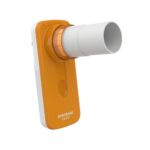
MIR Spirobank Oxi
MIR
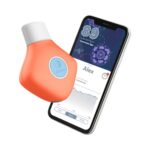
Aluna 2 Smart Spirometer
Aluna
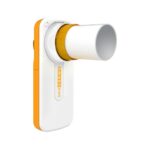
MIR Smart One
MIR
You're viewing this
MIR Smart One You're viewing this device
MIR
Clinical Context
Our #1-ranked home spirometers device demonstrated superior performance across key clinical metrics. Compare detailed specifications to make an evidence-based selection.
Clinical Recommendation
Final assessment and prescribing guidance
The MIR Smart One is an elite hardware choice for home respiratory monitoring. If you can navigate the app-centric design, you get clinical-grade accuracy that is rarely found in over-the-counter devices.
Recommend If
You want medical-grade precision and a detailed longitudinal digital record of your lung health (PEF and FEV1) to share with your doctor.
Avoid If
You want a device that works independently of a phone or you find mobile apps difficult to navigate.
Clinical Summary
Composite Score
Recommendation
Price Point
Where to Buy
Verified purchase options and current availability
CardiacDirect
Free shipping; FSA/HSA eligible.
MFI Medical
Free shipping in contiguous US; 30-day free returns.
MDMaxx
Medicare HCPCS code pending (approved as DME item by CMS).
Important Information
- • Prices and availability subject to change
- • Some devices may require a prescription
- • HSA / FSA eligibility: Usually Eligible
- • Purchase from authorized retailers for warranty protection
Alternative Devices
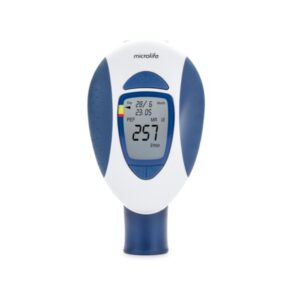
Hardware-wise, it outclasses most digital competitors due to its bi-directional turbine. While it lacks the on-board display found on the Microlife PF-100, its connectivity and software capabilities are more modern.