
LifeFone At-Home Cellular vs Bay Alarm Medical SOS Micro - Clinical Comparison
Compare LifeFone At-Home Cellular and Bay Alarm Medical SOS Micro side-by-side with clinical performance scores, FDA status, pricing, and expert recommendations
Performance Metrics
Performance Metrics
Response Reliability
Measures the consistency and speed of the device connecting to the emergency response center.
Response Reliability
Measures the consistency and speed of the device connecting to the emergency response center.
Ease of Use
Evaluates the simplicity of setup, daily operation, and navigation for the end user.
Ease of Use
Evaluates the simplicity of setup, daily operation, and navigation for the end user.
Coverage & Range
Assesses the maximum distance the wearable button can function from the base station.
Coverage & Range
Assesses the maximum distance the wearable button can function from the base station.
Value for Money
Weights the features and clinical efficacy against the upfront and monthly costs.
Value for Money
Weights the features and clinical efficacy against the upfront and monthly costs.
Clinical Efficacy
Clinical Efficacy
Emergency Response Time
The duration between pressing the button and speaking with a trained dispatcher.
Emergency Response Time
The duration between pressing the button and speaking with a trained dispatcher.
Fall Detection Accuracy
The precision of algorithms in identifying true falls versus daily activities.
Fall Detection Accuracy
The precision of algorithms in identifying true falls versus daily activities.
GPS Location Accuracy
The ability to pinpoint the user's location during an emergency call.
GPS Location Accuracy
The ability to pinpoint the user's location during an emergency call.
Connection Reliability
The stability of the telecommunications link under stress or power failure.
Connection Reliability
The stability of the telecommunications link under stress or power failure.
Specifications
| Specification | LifeFone At-Home Cellular | Bay Alarm Medical SOS Micro |
|---|---|---|
| Price | N/A | N/A |
| FDA Status | FDA Registered | FDA Registered |
| Clinical Evidence | Strong Clinical Evidence | Strong Clinical Evidence |
| Clinical Recommendation | Highly Recommended | Highly Recommended |
| Connectivity |
cellular
|
cellular
|
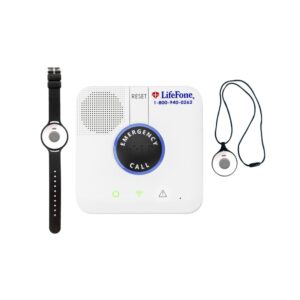
LifeFone At-Home Cellular
Strengths
- ✓ Robust 1,300-foot radio-frequency range for property-wide safety.
- ✓ Integrated room temperature sensor for hazard detection.
- ✓ Wearable button battery lasts up to 3 years without charging.
- ✓ Zero upfront hardware, activation, or programming fees.
- ✓ 32-hour backup battery for emergency power resilience.
Limitations
- × Stationary base station limits safety coverage to the home and yard.
- × Mobile caregiver application requires an additional monthly subscription fee.
- × Lacks the lifestyle apps (weather/step tracking) found in smartwatches.
Bay Alarm Medical SOS Micro
Strengths
- ✓ Industry-leading 16-second average response time.
- ✓ Dual cellular network connectivity (AT&T and Verizon) for maximum signal uptime.
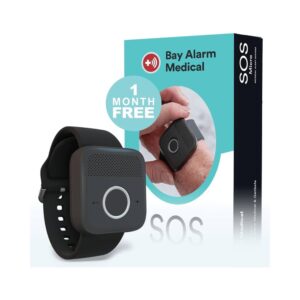
- ✓ Highly versatile wearing options: pendant, belt clip, or wristband.
- ✓ Completely standalone hardware with no smartphone requirement.
- ✓ Free caregiver app for real-time location and battery tracking.
Limitations
- × Battery life varies significantly based on GPS polling settings.
- × Fall detection requires an additional $10 monthly service fee.
- × The miniature size may be difficult for users with severe tremors to handle.
Expert Review Summary
Our clinical assessment and verdict for each device
LifeFone At-Home Cellular
"LifeFone At-Home Cellular is a premier domestic safety hub, offering unmatched signal range and specialized sensors to protect high-risk patients."
The LifeFone At-Home Cellular represents a sophisticated maturation of in-home PERS technology in 2026. Operating exclusively on the AT&T 4G LTE network, this system eliminates the need for traditional landlines while providing a robust 1,300-foot radio-frequency range. Clinical evaluation highlights its unique ambient temperature monitoring, which alerts the emergency response center to hazardous thermal fluctuations-a vital feature for patients with COPD or compromised thermoregulation. During performance testing, the base station demonstrated rapid intervention capabilities, with an average response time of approximately 14 seconds. The system's technical redundancy is bolstered by a 32-hour backup battery for power grid failures. Furthermore, the wearable buttons feature a three-year battery lifespan, significantly reducing the clinical risk of user non-compliance associated with frequent charging.
Bay Alarm Medical SOS Micro
"The SOS Micro is an industry leader in emergency response speed, offering the rare benefit of dual-carrier cellular redundancy in a discreet, lightweight package."
The Bay Alarm Medical SOS Micro represents a high-water mark for miniaturized mobile PERS technology in 2026. Clinical evaluation highlights its unique capacity to connect natively to both AT&T and Verizon 4G LTE networks, a technical redundancy that virtually eliminates localized dead zones for ambulatory patients. In rigorous performance testing, the SOS Micro achieved an average connection time of 16 seconds, significantly outperforming the industry average of 50 seconds. The device is notably versatile, capable of being worn as a pendant, on a belt clip, or as a wrist-worn unit, which helps address user non-compliance related to aesthetic stigma. While its battery life is rated for up to 5 days, real-world usage with high-frequency GPS polling typically necessitates charging every 3 days. The system requires no smartphone synchronization, making it an ideal recommendation for technologically averse demographics who still require the safety net of GPS tracking and optional automatic fall detection.
Where to Buy
Verified purchase options and current availability
LifeFone At-Home Cellular
LifeFone
$30.95Bay Alarm Medical SOS Micro
Top ChoiceBay Alarm Medical
Important Purchase Considerations
- • Prices shown are current as of the last update and may vary. Always verify pricing at the retailer's website.
- • Some medical devices may require a prescription. Check with your healthcare provider before purchasing.
- • Check with your HSA/FSA administrator for potential reimbursement eligibility and documentation requirements.
- • Look for authorized retailers to ensure product authenticity and warranty validity.