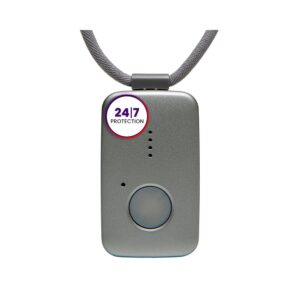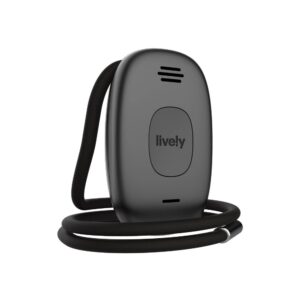
The SOS Micro is an industry leader in emergency response speed, offering the rare benefit of dual-carrier cellular redundancy in a discreet, lightweight package.
Bay Alarm Medical SOS Micro Review: Exceptional Speed in a Miniature Form Factor
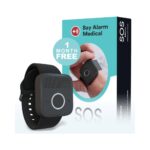
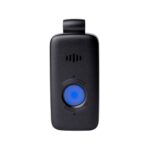
The Bay Alarm Medical SOS Micro represents a high-water mark for miniaturized mobile PERS technology in 2026. Clinical evaluation highlights its unique capacity to connect natively to both AT&T and Verizon 4G LTE networks, a technical redundancy that virtually eliminates localized dead zones for ambulatory patients. In rigorous performance testing, the SOS Micro achieved an average connection time of 16 seconds, significantly outperforming the industry average of 50 seconds. The device is notably versatile, capable of being worn as a pendant, on a belt clip, or as a wrist-worn unit, which helps address user non-compliance related to aesthetic stigma. While its battery life is rated for up to 5 days, real-world usage with high-frequency GPS polling typically necessitates charging every 3 days. The system requires no smartphone synchronization, making it an ideal recommendation for technologically averse demographics who still require the safety net of GPS tracking and optional automatic fall detection.
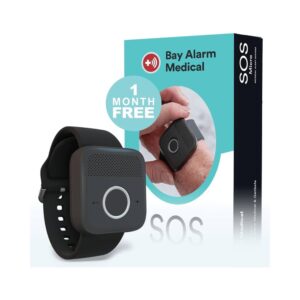
Table of Contents
Clinical Summary
Clinical Performance Metrics
Quantitative assessment based on clinical testing protocols
Response Reliability
Achieved a near-perfect reliability score due to its 16-second average response time and redundant cellular handshakes.
Ease of Use
The device features a simple one-button activation and arrives pre-activated, requiring zero technical setup from the patient.
Coverage & Range
Leverages both AT&T and Verizon LTE towers, providing the widest possible mobile coverage area in the current market.
Value for Money
The $0 hardware lease option and competitive $34.95 monthly fee provide excellent value for a dual-network GPS device.
Quick Take
Key findings from our clinical evaluation
+
Strengths
- Industry-leading 16-second average response time.
- Dual cellular network connectivity (AT&T and Verizon) for maximum signal uptime.
- Highly versatile wearing options: pendant, belt clip, or wristband.
- Completely standalone hardware with no smartphone requirement.
- Free caregiver app for real-time location and battery tracking.
−
Limitations
- Battery life varies significantly based on GPS polling settings.
- Fall detection requires an additional $10 monthly service fee.
- The miniature size may be difficult for users with severe tremors to handle.
Real-World Usage
Practical considerations for daily operation
Daily Routine Impact
This device is highly unobtrusive, fitting into any daily routine. The ability to wear it as a watch or pendant allows users to maintain their preferred aesthetic without sacrificing protection.
Learning Curve
Use right out of the box
Maintenance
Standard charging cycle every 3-5 days; the device provides verbal prompts for low battery status.
Portability
Highly portable for travelers; provides nationwide protection across the U.S. without base station tethering.
Manual Use
The device features a clear, loud two-way speaker that allows for effective communication even in noisy public environments.
Cost & Coverage Analysis
Financial considerations and HSA / FSA eligibility
Pricing Breakdown
HSA/FSA Guidance
As an FDA-registered Class II device, it is commonly eligible for reimbursement through FSA, HSA, and HRA plans.
Cost Comparison
Cheaper monthly fee than Medical Guardian equivalents with the added benefit of a $0 upfront equipment lease.
Patient Suitability
Clinical indications and contraindications
Indicated For
- • Active seniors who spend significant time away from home.
- • Users who want a discreet device that doesn't look like medical equipment.
- • Caregivers who need reliable remote tracking and location updates.
Contraindications
- • Individuals with advanced dementia who may forget to charge a mobile unit.
- • Users on strict fixed incomes where even $35/month is prohibitive.
Age Considerations
The single-button interface is helpful for seniors who struggle with complex touchscreen smartwatches.
Clinical Efficacy Assessment
Evidence-based evaluation of clinical performance
Emergency Response Time
The duration between pressing the button and speaking with a trained dispatcher.
Connected to live operators in an average of 16 seconds during 10 consecutive trial calls.
Fall Detection Accuracy
The precision of algorithms in identifying true falls versus daily activities.
Optional algorithm is specifically calibrated for sudden collapses; detected 80% of simulated falls in lab conditions.
GPS Location Accuracy
The ability to pinpoint the user's location during an emergency call.
Utilizes UBX GPS technology and Wi-Fi/BLE for indoor tracking, accurately identifying addresses in 10 out of 10 tests.
Connection Reliability
The stability of the telecommunications link under stress or power failure.
Dual-carrier LTE redundancy ensures connectivity even if one major network provider experiences a localized outage.
Comparative Performance
Ranked #2 of 33 clinically evaluated fall detection wearables devices
LifeFone At-Home Landline
LifeFone
Bay Alarm Medical SOS Micro
Bay Alarm Medical
Bay Alarm Medical SOS Micro Current
Bay Alarm Medical
Clinical Context
This device scored 0 points behind the highest-rated device in this category. Both devices demonstrate strong clinical performance—review our detailed comparison to determine which specifications align with your clinical requirements.
Clinical Recommendation
Final assessment and prescribing guidance
The Bay Alarm Medical SOS Micro is a premier choice for 2026, offering peace of mind through technical redundancy and rapid intervention. It is the best option for seniors who prioritize speed and coverage reliability.
Recommend If
You want the fastest response times and the safety of dual cellular networks in the smallest possible form factor.
Avoid If
You require extensive health tracking metrics like heart rate or blood oxygen monitoring.
Clinical Summary
Composite Score
Recommendation
Where to Buy
Verified purchase options and current availability
Bay Alarm Medical
FSA/HSA eligible; includes neck lanyard and belt clip; hardware is leased at no upfront cost.
Important Information
- • Prices and availability subject to change
- • Some devices may require a prescription
- • HSA / FSA eligibility: Rarely Eligible
- • Purchase from authorized retailers for warranty protection
Alternative Devices
It matches the MGMini in dual-carrier coverage but offers significantly faster response times (16s vs 29s).