
The premier choice for users seeking a traditional timepiece that doubles as an FDA-cleared, long-term cardiac and sleep monitoring tool[cite: 836, 947].
Withings ScanWatch 2 Review: Hybrid Elegance Meets Medically-Validated Cardiac Monitoring
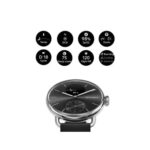
The Withings ScanWatch 2 (Model HWA10) is a sophisticated medical accessory that disguises its clinical capabilities within a hybrid analog design[cite: 834, 835]. It is primarily indicated for recording single-channel ECG rhythms and detecting Atrial Fibrillation (AFib) in adult patients[cite: 949, 950]. In clinical validation studies involving 262 subjects, the watch demonstrated a 96.3% sensitivity for AFib and 100% specificity for normal sinus rhythm on conclusive recordings, although 19.5% of strips were classified as inconclusive[cite: 1013, 1014]. Beyond cardiac care, the device tracks sleep duration and architecture, including light, deep, and REM stages, through its integrated photoplethysmography (PPG) and accelerometer sensors[cite: 836, 1179]. Its hardware construction is notably durable, utilizing stainless steel or titanium electrodes and a design rated for 30 days of typical use on a single charge[cite: 1001, 1004]. While it offers 'set-and-forget' convenience for heart and sleep health, it remains an informational screening tool rather than a diagnostic replacement[cite: 994, 995].
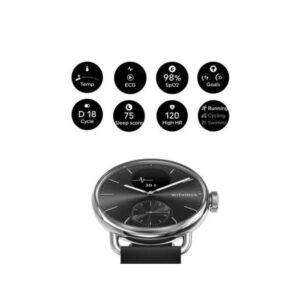
Table of Contents
Clinical Summary
Clinical Performance Metrics
Quantitative assessment based on clinical testing protocols
Diagnostic Accuracy
Strong performance in AFib detection with 96.3% sensitivity in clinical trials, though noise can lead to inconclusive results[cite: 1014].
Ease of Use
Automated data transfer via Bluetooth LE to the Withings app provides a seamless user experience upon waking[cite: 982, 1005].
Wearing Comfort
Traditional watch form factor with premium finishes is comfortable for daily wear but may feel substantial for some users overnight[cite: 834].
Value for Money
No mandatory subscription fees and a high-quality build justify the mid-range price point for a medical-grade hybrid watch[cite: 1001, 1004].
Quick Take
Key findings from our clinical evaluation
+
Strengths
- Industry-leading 30-day battery life on a single charge[cite: 1004].
- FDA-cleared single-channel ECG rhythms for AFib detection[cite: 947, 950].
- Durable construction with stainless steel or titanium electrodes[cite: 1001].
- Generates clinical-ready PDF reports for easy sharing with physicians[cite: 1000].
- Automatic background pulse rate monitoring for irregular heart rhythms[cite: 838].
−
Limitations
- Approximately 19.5% of ECG recordings may be classified as inconclusive in real-world settings[cite: 1014].
- Restricted to adult use (22+ years in the U.S. for clinical features)[cite: 971].
- Not recommended for users with cardiac pacemakers or other known arrhythmias besides AFib[cite: 841, 965].
Real-World Usage
Practical considerations for daily operation
Daily Routine Impact
Has minimal impact on daily routines due to its massive battery life; requires only one monthly charge and provides passive health oversight[cite: 1004].
Learning Curve
Master in an hour
Maintenance
Occasional cleaning of the sensors/electrodes; firmware updates via the Withings app[cite: 960, 1008].
Portability
High; only requires its dedicated charging dock once every few weeks[cite: 1004].
Manual Use
Hybrid design allows users to check time and basic metrics via the OLED screen on the watch face without a phone[cite: 1006].
Cost & Coverage Analysis
Financial considerations and HSA / FSA eligibility
Pricing Breakdown
HSA/FSA Guidance
May be eligible for HSA/FSA spending as a medically cleared ECG device[cite: 947].
Cost Comparison
Competitively priced for a premium hybrid medical device compared to the Apple Watch Ultra 2[cite: 1001, 1293].
Patient Suitability
Clinical indications and contraindications
Indicated For
- • Individuals who prefer the look of a traditional watch over a modern fitness tracker[cite: 834].
- • Users needing reliable, medical-grade AFib screening at home[cite: 951].
- • Those who find daily wearable charging burdensome[cite: 1004].
Contraindications
- • Individuals with implanted pacemakers or ICDs[cite: 965].
- • Users seeking comprehensive metabolic health tracking (e.g., AGEs index) found in smartwatches[cite: 1201].
Age Considerations
Clinical features are intended for users 22 years of age or older in the U.S.[cite: 971].
Clinical Efficacy Assessment
Evidence-based evaluation of clinical performance
Sleep Stage Identification
Assesses the accuracy of identifying REM, Light, and Deep sleep states.
Utilizes movement and heart rate to categorize four sleep states, matching standard consumer wearable benchmarks[cite: 1179, 1180].
Respiratory Event Detection
Evaluates accuracy in detecting individual breathing disturbances.
Monitors pulse rate and irregular rhythms but lacks the pneumatic precision of dedicated sleep mats for respiratory events[cite: 838, 990].
In-Lab PSG Correlation
Measures how the device results correlate with in-lab polysomnography.
Demonstrated high correlation in cardiac rhythm classification compared to cardiologist review[cite: 1013].
Comparative Performance
Ranked #16 of 25 clinically evaluated home sleep tests devices
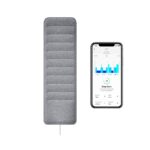
Withings Sleep Analyzer
Withings
Sunrise Home Sleep Test
Sunrise SA
Withings ScanWatch 2 (HSAT)
Withings
You're viewing this
Withings ScanWatch 2 (HSAT) You're viewing this device
Withings
Clinical Context
Our #1-ranked home sleep tests device demonstrated superior performance across key clinical metrics. Compare detailed specifications to make an evidence-based selection.
Clinical Recommendation
Final assessment and prescribing guidance
The Withings ScanWatch 2 is the gold standard for hybrid health technology. It provides a rare balance of high-end clinical validation for heart health and an elegant analog design that eliminates charging anxiety.
Recommend If
You want a clinically validated ECG watch that looks like a luxury timepiece and lasts for a full month on one charge.
Avoid If
You have an implanted cardiac device or require high-resolution brain-wave sleep data.
Clinical Summary
Composite Score
Recommendation
Price Point
Where to Buy
Verified purchase options and current availability
Withings Official Store
Rx required; HSA/FSA eligible.
Best Buy
Verification of Rx status may be required for certain medical features.
Important Information
- • Prices and availability subject to change
- • Some devices may require a prescription
- • HSA / FSA eligibility: Rarely Eligible
- • Purchase from authorized retailers for warranty protection