The iHealth Push is incredibly lightweight and portable, offering comfortable inflation-phase readings and Bluetooth connectivity, though it lacks multi-user local memory.
iHealth Push Wrist Blood Pressure Monitor Review: Ultra-Portable Bluetooth Tracking
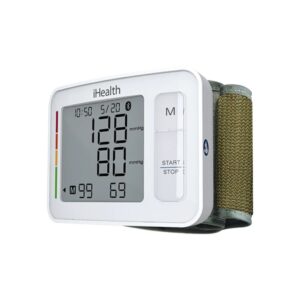
The iHealth Push (KD-723) stands out for its ultra-slim profile and portability, weighing a mere 96 grams. It is STRIDE BP approved, offering clinical validation for reliable home monitoring. Unlike monitors that squeeze tightly and read upon deflation, the iHealth Push utilizes inflation-phase technology for a faster, more comfortable measurement experience. While it lacks the electronic active positioning sensors found in some premium models, it cleverly utilizes its hard plastic carrying case as a physical armrest to help users maintain the correct heart-level alignment. The device stores up to 99 readings locally for a single user, but unlocks unlimited storage and easy data sharing via the iHealth MyVitals app over Bluetooth 4.0. Its main limitations are the smaller cuff size (maximum 7.7 inches) and the lack of local multi-user support.
iHealth Push Wrist Blood Pressure Monitor
iHealth
Our Score
Table of Contents
Clinical Summary
Clinical Performance Metrics
Quantitative assessment based on clinical testing protocols
Measurement Accuracy
STRIDE BP approved and highly accurate, provided the user effectively uses the physical case to maintain heart-level positioning.
Cuff Fit & Comfort
Very comfortable due to inflation-phase measuring, but the 7.7-inch maximum circumference restricts it from fitting larger wrists.
Ease of Use
Simple one-button operation and a clear high-contrast LCD. Relying on a physical case for positioning is clever but less foolproof than electronic guidance.
Overall Value
A very affordable, validated Bluetooth monitor that excels in portability, though the single-user local memory limits its utility for couples.
Quick Take
Key findings from our clinical evaluation
+
Strengths
- Ultra-lightweight design weighing only 96 grams
- Fast and comfortable inflation-phase measurements
- STRIDE BP approved for clinical accuracy
- Carrying case doubles as a physical positioning armrest
- Bluetooth connectivity with the iHealth MyVitals app
−
Limitations
- Local memory is limited to a single user (99 readings)
- Cuff accommodates a maximum wrist circumference of only 7.7 inches
- Lacks an active electronic positioning sensor
Real-World Usage
Practical considerations for daily operation
Daily Routine Impact
Its extremely compact size makes it effortless to slip into a purse or bag, ideal for users who need to check their blood pressure at work or while traveling.
Learning Curve
Use right out of the box
Maintenance
Requires replacement of two AAA batteries (lasts for approximately 170 measurements) and occasional wiping with a soft cloth.
Portability
Exceptional. At just 96 grams and featuring an ultra-slim profile, it is one of the most travel-friendly monitors available.
Manual Use
Straightforward for a single user. The high-contrast digital LCD is easy to read, and it stores 99 measurements locally without needing a smartphone.
Cost & Coverage Analysis
Financial considerations and HSA / FSA eligibility
Pricing Breakdown
HSA/FSA Guidance
Often eligible for FSA/HSA reimbursement; check with your specific plan administrator.
Cost Comparison
Priced very affordably, especially for a Bluetooth-enabled device with STRIDE BP validation.
Patient Suitability
Clinical indications and contraindications
Indicated For
- • Frequent travelers seeking an ultra-compact device
- • Single users looking for simple app integration
- • Patients who find standard deflation-phase cuffs painful
Contraindications
- • Individuals with wrist circumferences over 7.7 inches
- • Couples looking to share a single device with partitioned local memory
Age Considerations
Suitable for adults; however, older adults with limited mobility might prefer a device with an electronic positioning sensor rather than relying on a physical armrest.
Clinical Efficacy Assessment
Evidence-based evaluation of clinical performance
Measurement Accuracy
The ability of the device to provide true and clinically valid blood pressure readings.
ISO compliant and listed on the STRIDE BP registry, verifying its diagnostic accuracy for adult populations.
Position Sensitivity
How well the device guides the user to the correct physical posture (heart level) and compensates for hydrostatic pressure differences.
Lacks an active electronic positioning sensor; instead, it relies on a passive design solution where the carrying case serves as an armrest.
Repeatability / Precision
The consistency of readings when multiple measurements are taken in succession under the same conditions.
Provides consistent readings for a single user, though it does not feature an automatic multi-reading averaging mode.
Arrhythmia Detection Sensitivity
The monitor's ability to detect and alert the user to irregular heartbeats during a standard measurement cycle.
Includes standard irregular heartbeat detection to flag pulse variations during the inflation cycle.
Comparative Performance
Ranked #7 of 12 clinically evaluated wrist blood pressure monitors devices
Oxiline Pressure XS Mini
Oxiline
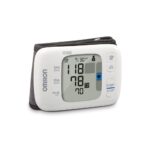
Omron Gold Wireless Wrist Blood Pressure Monitor
Omron
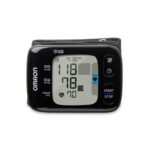
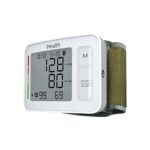
iHealth Push Wrist Blood Pressure Monitor
iHealth
You're viewing this
iHealth Push Wrist Blood Pressure Monitor You're viewing this device
iHealth
Clinical Context
Our #1-ranked wrist blood pressure monitors device demonstrated superior performance across key clinical metrics. Compare detailed specifications to make an evidence-based selection.
Clinical Recommendation
Final assessment and prescribing guidance
The iHealth Push is a highly portable, clinically validated wrist monitor that excels in travel scenarios. Its inflation-phase comfort and smart app integration make it a great choice for single users with average-sized wrists.
Recommend If
You want an ultra-lightweight, Bluetooth-enabled monitor for travel and personal tracking.
Avoid If
You need to track two users on the device itself or have a wrist larger than 7.7 inches.
Clinical Summary
Composite Score
Recommendation
Price Point
Where to Buy
Verified purchase options and current availability
iHealth Labs
FREE Delivery & Returns within the first 30 days of purchase.
Walmart
N/A (not available)
Important Information
- • Prices and availability subject to change
- • Some devices may require a prescription
- • HSA / FSA eligibility: Usually Eligible
- • Purchase from authorized retailers for warranty protection
Alternative Devices
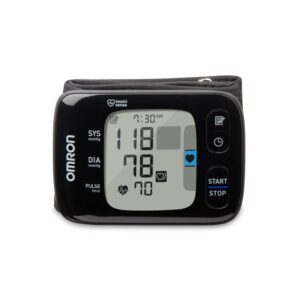
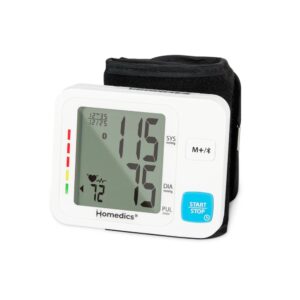
It is much lighter and more compact than the Omron 7 Series and HoMedics 600, but lacks the multi-user local memory and active electronic positioning features those competitors offer.