The Fitbit Sense 2 is an excellent health companion for users who prioritize stress management and passive heart health monitoring over advanced smartwatch productivity.
Fitbit Sense 2 Review: A Holistic Approach to Stress and Heart Health
The Fitbit Sense 2 is a refined health wearable that prioritizes long-term wellness tracking through its comprehensive sensor suite. Its primary clinical features include an FDA-cleared ECG app and an Irregular Heart Rhythm Notification (IHRN) system, both of which were validated in the massive Fitbit Heart Study. The device introduces the cEDA (continuous electrodermal activity) sensor, which passively monitors skin conductance throughout the day to identify 'Body Response' events related to stress. While its ECG app is a single-lead (Lead I) spot-check tool requiring user initiation, the IHRN system works passively in the background using PPG technology. Clinical validation studies have shown the IHRN system has a positive predictive value of 98.2% for detecting AFib during periods of inactivity. The Sense 2 also monitors blood oxygen (SpO2) and skin temperature variations overnight. While it lacks the third-party app ecosystem of Wear OS or watchOS, its 6-day battery life and focused health metrics make it a powerful tool for longitudinal health surveillance.
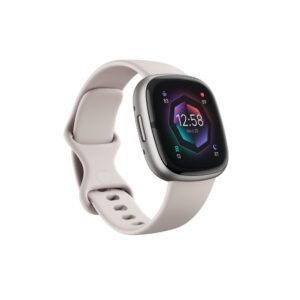
Table of Contents
Clinical Summary
Clinical Performance Metrics
Quantitative assessment based on clinical testing protocols
ECG Accuracy
The single-lead ECG app demonstrated 98.7% sensitivity for AFib and 100% specificity for sinus rhythm in multi-site clinical trials, though inconclusive rates can reach 20% in real-world use.
Ease of Use
The inclusion of a physical side button and an intuitive tiled interface makes the Sense 2 easier to navigate than its predecessor, with a very low learning curve for health checks.
Health Feature Set
Boasts Fitbit's most complete sensor array, including continuous EDA for stress, skin temperature, SpO2, and advanced sleep profiling.
Value for Money
Priced competitively for a flagship health watch; offers superior battery life and more diverse health sensors than most rivals in the sub-$300 category.
Quick Take
Key findings from our clinical evaluation
+
Strengths
- Industry-leading 6+ day battery life for consistent monitoring
- Continuous EDA sensor provides unique insights into daily stress levels
- FDA-cleared ECG app and validated IHRN passive heart rhythm monitoring
- Comprehensive sleep tracking with detailed monthly Sleep Profiles
- Thin, lightweight design that is comfortable for 24/7 wear
−
Limitations
- Full access to advanced health metrics requires a Fitbit Premium subscription
- Lack of third-party app support limits its utility as a 'smart' watch
- ECG app and heart alerts are only for users 22 years of age or older
Real-World Usage
Practical considerations for daily operation
Daily Routine Impact
The Sense 2 fits seamlessly into a daily wellness routine, acting as a passive health sentinel that requires charging only once a week while providing actionable stress and heart data.
Learning Curve
Master in an hour
Maintenance
Periodic cleaning of the sensor window and charging contact pins; keeping the band clean and dry after exercise or swimming.
Portability
Excellent; the long battery life means users can often travel for a week without needing to pack the charging cable.
Manual Use
While the watch can display real-time HR and perform ECG recordings standalone, it relies on the Fitbit app for all long-term data storage and detailed analysis.
Cost & Coverage Analysis
Financial considerations and HSA / FSA eligibility
Pricing Breakdown
1-Year Total
$369.83
3-Year Total
$609.59
HSA/FSA Guidance
Check with your employer's wellness program, as many offer incentives or reimbursement for Fitbit devices. Eligible for purchase with HSA/FSA funds.
Cost Comparison
Cheaper than the Apple Watch Series 10 and Garmin Venu 4, offering a more holistic stress-tracking suite at the expense of fewer productivity features.
Patient Suitability
Clinical indications and contraindications
Indicated For
- • Users focused on stress management and mental well-being
- • Individuals wanting passive heart health screening without daily charging
- • Patients needing a comfortable, detailed sleep tracking solution
Contraindications
- • Users seeking a true 'smartwatch' with a deep third-party app ecosystem
- • Elite athletes requiring ultra-precise heart rate tracking at peak intensity
Age Considerations
The ECG app and IHRN features are strictly for users 22 years of age and older. Not intended for use by minors.
Clinical Efficacy Assessment
Evidence-based evaluation of clinical performance
AFib Detection Accuracy
The accuracy of the device in correctly identifying Atrial Fibrillation.
The PPG-based IHRN algorithm achieved a positive predictive value of 98.2% for AFib in the Fitbit Heart Study, while the ECG app provides highly accurate spot-checks.
Heart Rate Monitoring Accuracy
The precision of heart rate tracking during rest and physical activity.
The multi-path optical sensor is highly accurate at rest and during steady-state aerobic activity, though it may lag during rapid heart rate transitions in high-intensity intervals.
SpO2 Measurement Accuracy
How closely blood oxygen readings match medical-grade pulse oximeters.
Reliable for detecting overnight trends and hypoxemia signs, with bias typically staying within 1.2% compared to medical pulse oximeters.
Health Alert Reliability
The dependability of automated alerts for irregular rhythms or high/low heart rates.
Highly dependable background notifications for irregular rhythms and high/low resting heart rates, optimized for periods of inactivity to minimize false positives.
Comparative Performance
Ranked #4 of 7 clinically evaluated smartwatches with ecg devices
Apple Watch Series 10
Apple
Samsung Galaxy Watch 8 Classic
Samsung
Fitbit Sense 2
Fitbit
You're viewing this
Fitbit Sense 2 You're viewing this device
Fitbit
Clinical Context
Our #1-ranked smartwatches with ecg device demonstrated superior performance across key clinical metrics. Compare detailed specifications to make an evidence-based selection.
Clinical Recommendation
Final assessment and prescribing guidance
The Fitbit Sense 2 is a triumph of wellness engineering. It offers the most comprehensive health sensing in the Fitbit lineup, providing an accessible and accurate safety net for both mental and cardiac health.
Recommend If
You want the best battery life in a health-focused watch and are particularly interested in managing stress alongside heart rhythm.
Avoid If
You need a high-performance productivity watch with extensive third-party apps or the highest level of athletic heart rate precision.
Clinical Summary
Composite Score
Recommendation
Price Point
Where to Buy
Verified purchase options and current availability
Fitbit Direct
FSA/HSA eligible; typically includes 6 months of Fitbit Premium for new users.
Amazon
Frequently discounted; eligible for standard Amazon return policy.
Target
5% RedCard savings available; in-store pickup available.
Important Information
- • Prices and availability subject to change
- • Some devices may require a prescription
- • HSA / FSA eligibility: Usually Eligible
- • Purchase from authorized retailers for warranty protection
Alternative Devices
The Sense 2 beats competitors in battery life and passive stress tracking, though it falls behind in app functionality and ecosystem integration.