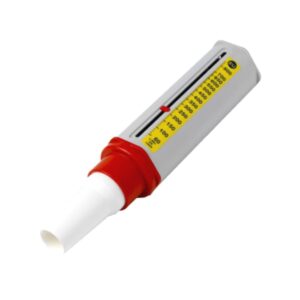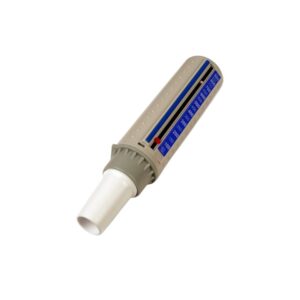
The Mini-Wright Low Range is a highly dependable mechanical monitor that offers the necessary resolution for children and patients with low lung capacity.
Clement Clarke Mini-Wright Low Range Peak Flow Meter Review: Precision Pediatric Monitoring
The Clement Clarke Mini-Wright Low Range is a mechanical, Class II medical device tailored for populations where standard range meters lack the sensitivity to capture small but significant changes in lung function. While the standard model covers up to 880 L/min, this low-range version is typically scaled for 30-400 L/min (or 50-300 L/min in pediatric-specific configurations), allowing for much clearer increments at the bottom end of the scale. It utilizes the same clinically-proven spring-and-piston mechanism as its parent model, capturing the peak velocity of a forced exhalation. Our assessment highlights its material integrity, utilizing high-impact medical polymers and a stainless steel internal spring that resists fatigue. A key safety feature is the internal one-way valve, which prevents the patient from inhaling through the device, thereby minimizing the risk of cross-contamination and moisture buildup. While it does not offer digital data logging or FEV1 measurement, its status as a clinically-validated tool makes it a staple for establishing baselines in pediatric asthma management and monitoring severe COPD cases where flow rates are chronically low.
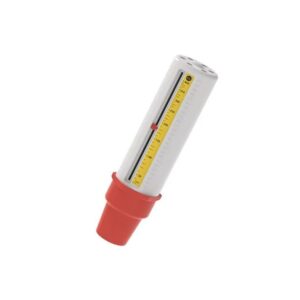
Clement Clarke Mini-Wright Low Range Peak Flow Meter
Clement Clarke
Our Score
Table of Contents
Clinical Summary
Clinical Performance Metrics
Quantitative assessment based on clinical testing protocols
Measurement Accuracy
Individually calibrated at the factory to meet or exceed international standards, providing specialized precision for low-flow exhalations.
Ease of Use
Zero-power mechanical design is immediate and unambiguous; the expanded scale makes it easier for caregivers to read small changes in pediatric performance.
Build Quality
Rugged medical-grade construction designed for a 3-year service life; the internal mechanism is shielded against environmental factors.
Value for Money
A high-pedigree clinical tool at an affordable price point, offering long-term reliability without the recurring costs of batteries or sensors.
Quick Take
Key findings from our clinical evaluation
+
Strengths
- Specialized low-range scale provides high resolution for pediatric monitoring.
- Internal one-way valve protects against inhalation of contaminants.
- Battery-free operation ensures the device is always ready for use.
- Individually calibrated at the factory for medical-grade precision.
- Robust build quality suitable for use in schools or travel.
−
Limitations
- Upper measurement limit (approx 400 L/min) is insufficient for healthy adults.
- Purely mechanical device with no digital logging or memory.
- Does not measure advanced parameters such as FEV1.
Real-World Usage
Practical considerations for daily operation
Daily Routine Impact
Requires no setup or charging, making it ideal for the frequent monitoring required in pediatric asthma management. Its lightweight design allows it to be carried easily in a child's school bag.
Learning Curve
Use right out of the box
Maintenance
Periodic cleaning of the external mouthpiece and body with warm soapy water; thorough air drying is required before the next use.
Portability
Highly portable; self-contained and durable with no fragile electronic components.
Manual Use
Excellent; the physical slider and expanded numeric scale provide immediate feedback that is highly intuitive for caregivers.
Cost & Coverage Analysis
Financial considerations and HSA / FSA eligibility
Pricing Breakdown
HSA/FSA Guidance
Often eligible for reimbursement as a primary monitoring tool under HCPCS code A4614. Generally compatible with HSA/FSA plans.
Cost Comparison
Priced similarly to the standard model, offering better value for low-flow patients than a standard meter they cannot effectively trigger.
Patient Suitability
Clinical indications and contraindications
Indicated For
- • Young children (ages 5+) requiring daily asthma monitoring.
- • Seniors with significantly reduced lung capacity or severe COPD.
- • Users who want a durable, clinically-validated mechanical meter.
Contraindications
- • Healthy adults or adolescents with flow rates exceeding 400 L/min.
- • Patients requiring automatic digital tracking to a smartphone.
Age Considerations
Designed specifically for pediatric use and adult subjects with low lung capacity.
Clinical Efficacy Assessment
Evidence-based evaluation of clinical performance
Peak Flow Accuracy
Measures the precision of Peak Expiratory Flow rate readings.
Validated through ATS standard waveform testing, maintaining high fidelity across the 30-400 L/min specialized scale.
Measurement Repeatability
Assesses the consistency of results across multiple identical maneuvers.
Like all mechanical meters, it is susceptible to minor spring fatigue over multi-year use, though it remains highly consistent over its recommended service life.
Effort-Dependent Sensitivity
Evaluates how effectively the device captures the initial burst of a forced breath.
Optimized for low exhalation pressure, making it much more responsive to the efforts of pediatric patients than standard range models.
Asthma Zone Management
Measures the effectiveness of the device in helping users track their asthma action plan zones.
Uses manually adjustable color-coded markers (Green, Yellow, Red) and includes a tracking diary for manual trend monitoring.
Comparative Performance
Ranked #8 of 22 clinically evaluated peak flow meters devices
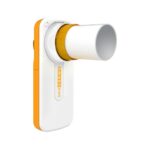
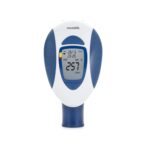
Microlife Digital Peak Flow Meter (PF-100)
Microlife
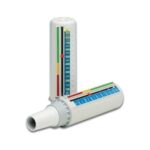
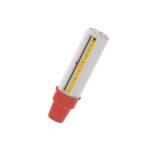
Clement Clarke Mini-Wright Low Range Peak Flow Meter
Clement Clarke
You're viewing this
Clement Clarke Mini-Wright Low Range Peak Flow Meter You're viewing this device
Clement Clarke
Clinical Context
Our #1-ranked peak flow meters device demonstrated superior performance across key clinical metrics. Compare detailed specifications to make an evidence-based selection.
Clinical Recommendation
Final assessment and prescribing guidance
The Clement Clarke Mini-Wright Low Range is the definitive mechanical choice for low-flow populations. Its specialized resolution and clinical pedigree make it an essential tool for pediatrics in 2026.
Recommend If
You are monitoring a child or a patient with severely restricted lung function who needs clear, accurate readings below 400 L/min.
Avoid If
You are a healthy adult or require FEV1 tracking and automatic digital logging.
Clinical Summary
Composite Score
Recommendation
Alternative Devices
It offers superior precision at low flow rates compared to universal-range meters like the Omron Peak Air. It matches the build quality of the Mini-Wright Standard but trades high-end range for low-end sensitivity.