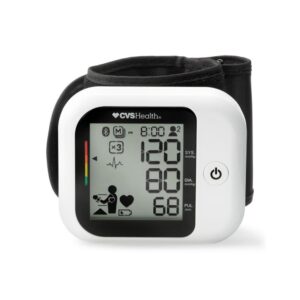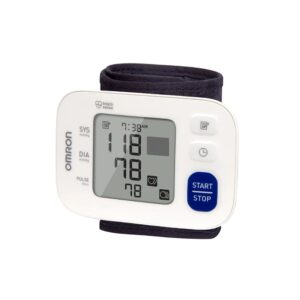
The HealthSmart Standard Series provides basic, offline blood pressure tracking with dual-user memory but lacks the advanced features and rigorous validation of premium alternatives.
HealthSmart Standard Series Universal Wrist Blood Pressure Monitor Review: Basic Offline Tracking
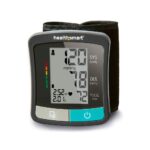
The HealthSmart Standard Series Universal Wrist Blood Pressure Monitor is a straightforward, budget-friendly device intended for casual home use. It features an ultra-compact display unit with a standard 1.75 by 1.25-inch LCD that shows systolic, diastolic, and pulse readings alongside a visual BP guide. The monitor can store up to 120 readings partitioned between two users (60 each) and includes a useful 3-reading clinical averaging function. While it is FDA 510(k) compliant and claims clinical accuracy based on equivalent technology, it lacks the published, peer-reviewed clinical validation found in top-tier medical monitors. Additionally, it operates entirely offline, meaning users must manually record their data if they wish to share it with their healthcare provider. Despite these limitations, its wide-range cuff (5.3 to 8.5 inches) and irregular heartbeat detection make it a functional entry-level option.
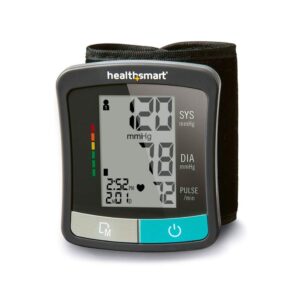
HealthSmart Standard Series Universal Wrist Blood Pressure Monitor
HealthSmart
Our Score
Table of Contents
Clinical Summary
Clinical Performance Metrics
Quantitative assessment based on clinical testing protocols
Measurement Accuracy
FDA 510(k) cleared but lacks the independent peer-reviewed registry validation of its premium competitors.
Cuff Fit & Comfort
The universal cuff easily accommodates a wide range of adult wrists from 5.3 to 8.5 inches.
Ease of Use
Simple to operate with basic buttons, but the smaller 1.75 x 1.25-inch non-backlit screen can be harder to read for some users.
Overall Value
A decent entry-level device, though at its price point, it faces stiff competition from monitors with larger screens or Bluetooth capabilities.
Quick Take
Key findings from our clinical evaluation
+
Strengths
- Accommodates two users with 60 memory slots each
- Wide-range cuff fits wrists up to 8.5 inches
- Automatically averages the last 3 readings
- Ultra-compact and lightweight display unit
- Includes a sleek storage case for travel
−
Limitations
- Completely offline with no Bluetooth app connectivity
- Small 1.75 x 1.25-inch non-backlit LCD screen
- Lacks independent clinical registry validation
Real-World Usage
Practical considerations for daily operation
Daily Routine Impact
Simple to slip on and use for a quick check, though keeping long-term records requires manual logging with a pen and paper since it cannot sync to a phone.
Learning Curve
Use right out of the box
Maintenance
Requires occasional replacement of the two AAA batteries and basic wipe-downs of the cuff to keep it clean.
Portability
Highly portable with its ultra-compact display unit and included storage case, easily fitting into a small bag.
Manual Use
Adequate. It relies entirely on its on-device memory, which is easy to access, though navigating the interface on the smaller screen can be slightly less intuitive than on larger models.
Cost & Coverage Analysis
Financial considerations and HSA / FSA eligibility
Pricing Breakdown
HSA/FSA Guidance
Often eligible for FSA/HSA reimbursement as an over-the-counter medical device, but check with your specific plan.
Cost Comparison
Priced around $59, it sits in the entry-level tier but faces stiff competition from devices that cost only slightly more yet include Bluetooth or larger screens.
Patient Suitability
Clinical indications and contraindications
Indicated For
- • Users looking for a simple, offline monitor
- • Couples needing basic dual-user memory partitioning
- • Individuals with larger wrists up to 8.5 inches
Contraindications
- • Users with visual impairments who need a larger or backlit screen
- • Patients needing rigorously validated devices for strict diagnostic tracking
Age Considerations
The smaller, non-backlit screen may be difficult for older adults or visually impaired individuals to read clearly in dim lighting.
Clinical Efficacy Assessment
Evidence-based evaluation of clinical performance
Measurement Accuracy
The ability of the device to provide true and clinically valid blood pressure readings.
FDA 510(k) cleared but lacks extensive independent peer-reviewed validation studies.
Position Sensitivity
How well the device guides the user to the correct physical posture (heart level) and compensates for hydrostatic pressure differences.
No electronic positioning guide; relies entirely on the user following manual instructions to maintain heart-level posture.
Repeatability / Precision
The consistency of readings when multiple measurements are taken in succession under the same conditions.
Features a 3-reading clinical average function to help smooth out single-reading variances.
Arrhythmia Detection Sensitivity
The monitor's ability to detect and alert the user to irregular heartbeats during a standard measurement cycle.
Includes standard irregular heartbeat detection to flag potential pulse irregularities during measurement.
Comparative Performance
Ranked #11 of 12 clinically evaluated wrist blood pressure monitors devices
Oxiline Pressure XS Mini
Oxiline
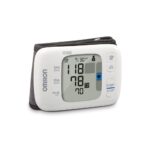
Omron Gold Wireless Wrist Blood Pressure Monitor
Omron
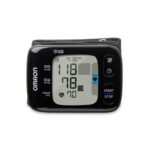
HealthSmart Standard Series Universal Wrist Blood Pressure Monitor
HealthSmart
You're viewing this
HealthSmart Standard Series Universal Wrist Blood Pressure Monitor You're viewing this device
HealthSmart
Clinical Context
Our #1-ranked wrist blood pressure monitors device demonstrated superior performance across key clinical metrics. Compare detailed specifications to make an evidence-based selection.
Clinical Recommendation
Final assessment and prescribing guidance
The HealthSmart Standard Series is a functional, no-frills wrist monitor. While it handles basic offline tracking well, users willing to spend a little more can find devices with better screens, Bluetooth connectivity, and stronger clinical validation.
Recommend If
You want a very basic, compact offline monitor that can track two users and fit a larger wrist.
Avoid If
You want smartphone connectivity, a large backlit screen, or a rigorously validated clinical device.
Clinical Summary
Composite Score
Recommendation
Price Point
Where to Buy
Verified purchase options and current availability
CVS Pharmacy
Pricing and availability may vary
Important Information
- • Prices and availability subject to change
- • Some devices may require a prescription
- • HSA / FSA eligibility: Usually Eligible
- • Purchase from authorized retailers for warranty protection
Alternative Devices
It offers dual-user memory which the Omron 3 Series lacks, but falls behind the CVS Health Advanced monitor which features a much larger, backlit display for easier reading.