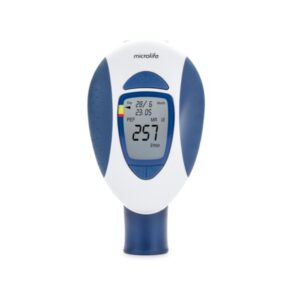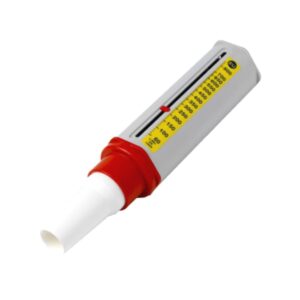
The Mini-Wright Digital is a robust and highly hygienic monitor that excels in multi-patient or clinical environments thanks to its fully submersible, sealed design.
Clement Clarke Mini-Wright Digital Review: Rugged, Waterproof Accuracy
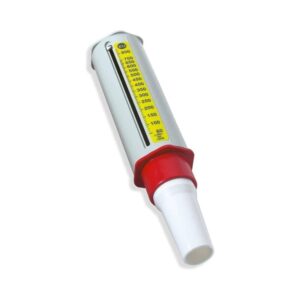
The Clement Clarke Mini-Wright Digital is a professional-grade electronic Peak Flow Meter (PFM) and FEV1 monitoring device designed for both home and clinical use. Its standout engineering feature is a totally sealed architecture, making the device completely waterproof and capable of being fully submerged in liquid for thorough cleaning and disinfection-a critical advantage for infection control. Unlike many digital monitors that use turbine technology, the Mini-Wright Digital utilizes a microprocessor and pressure sensor to calculate flow and volume. Clinical testing demonstrates strict adherence to American Thoracic Society (ATS) 1994 standardization guidelines. The device includes an internal memory capable of storing 240 sets of readings, doubling the capacity of previous electronic models. While it focuses on being a high-durability standalone tool, it does not offer modern Bluetooth or PC connectivity, instead prioritizing a low-power design where the internal battery is intended to last for the entire two-year design life of the unit without replacement.
Clement Clarke Mini-Wright Digital
Clement Clarke
Our Score
Table of Contents
Clinical Summary
Clinical Performance Metrics
Quantitative assessment based on clinical testing protocols
Measurement Accuracy
Meets ATS 1994 standards for precision, with high resolution at lower flow rates to capture subtle changes in pediatric lung function.
Ease of Use
Features straightforward operation with a large memory for review, though the lack of digital data export requires manual entry for long-term clinical records.
Build Quality
Uniquely engineered with a totally sealed, waterproof housing that allows for full submersion during sanitation.
Value for Money
While it lacks smartphone connectivity, its extreme durability and FEV1 tracking offer significant value for long-term clinical or heavy home use.
Quick Take
Key findings from our clinical evaluation
+
Strengths
- Waterproof, sealed design allows for full submersion during cleaning.
- Measures both Peak Flow (PEF) and FEV1 parameters.
- Large internal memory stores up to 240 measurement sets.
- Rugged build quality designed to withstand clinical environments.
- Meets or exceeds ATS technical standards for accuracy.
−
Limitations
- Does not feature Bluetooth or smartphone connectivity.
- Battery is not user-replaceable (designed for unit life).
- Lacks an automated digital interface for asthma zone calculation.
Real-World Usage
Practical considerations for daily operation
Daily Routine Impact
The device is portable and battery-operated, fitting easily into a daily routine. Its large memory allows users to record results manually at their convenience rather than after every blow.
Learning Curve
Use right out of the box
Maintenance
Periodic sanitation via submersion in water or disinfecting liquid; no battery maintenance is required for the unit's lifespan.
Portability
Highly portable; the handheld size and lack of required accessories make it ideal for travel.
Manual Use
Excellent standalone performance; the device is self-contained and provides all necessary data on-screen without requiring external software.
Cost & Coverage Analysis
Financial considerations and HSA / FSA eligibility
Pricing Breakdown
HSA/FSA Guidance
Often eligible for reimbursement under HCPCS code A4614; consult your provider for specific DME coverage details.
Cost Comparison
Priced higher than mechanical meters but offers unique digital memory and waterproof features that justify the cost for specific use cases.
Patient Suitability
Clinical indications and contraindications
Indicated For
- • Clinicians requiring a submersible device for multi-patient usage.
- • Users needing FEV1 tracking in a rugged, non-connected format.
- • Patients who prioritize hygiene and durability over app features.
Contraindications
- • Users who want automatic data syncing to a smartphone or computer.
- • Individuals looking for the lowest-cost mechanical peak flow meter.
Age Considerations
Clinically validated for both pediatric and adult subject use.
Clinical Efficacy Assessment
Evidence-based evaluation of clinical performance
Peak Flow Accuracy
Measures the precision of Peak Expiratory Flow rate readings.
Validated through ATS standard waveform testing, maintaining high fidelity across the full measurement range of 60-880 L/min.
Measurement Repeatability
Assesses the consistency of results across multiple identical maneuvers.
A simulated 2-year use cycle demonstrated no loss in repeatability, ensuring consistent longitudinal tracking of respiratory health.
Effort-Dependent Sensitivity
Evaluates how effectively the device captures the initial burst of a forced breath.
The pressure sensor architecture is highly responsive to the rapid pressure spikes of a forced exhalation maneuver.
Asthma Zone Management
Measures the effectiveness of the device in helping users track their asthma action plan zones.
Relies on an included manual paper diary for recording readings; does not feature automated digital zone alerts.
Comparative Performance
Ranked #16 of 22 clinically evaluated peak flow meters devices
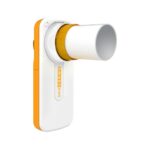
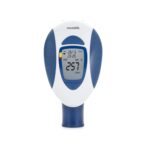
Microlife Digital Peak Flow Meter (PF-100)
Microlife
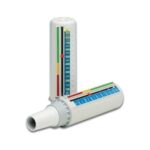
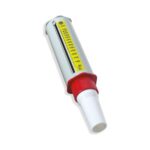
Clement Clarke Mini-Wright Digital
Clement Clarke
You're viewing this
Clement Clarke Mini-Wright Digital You're viewing this device
Clement Clarke
Clinical Context
Our #1-ranked peak flow meters device demonstrated superior performance across key clinical metrics. Compare detailed specifications to make an evidence-based selection.
Clinical Recommendation
Final assessment and prescribing guidance
The Clement Clarke Mini-Wright Digital is an exceptionally durable standalone monitor. While it misses modern app connectivity, its clinical precision and waterproof design make it a top choice for durability-focused users.
Recommend If
You want a clinically accurate, waterproof digital monitor that tracks FEV1 and does not require smartphone pairing.
Avoid If
You require a device that automatically logs your data into a mobile app or desktop software.
Clinical Summary
Composite Score
Recommendation
Price Point
Alternative Devices
It is significantly more durable than the Microlife PF-100 but lacks its USB connectivity. Compared to mechanical meters, it offers greater precision and electronic data storage.