
The quietest high-pressure pediatric compressor on the market, blending a comforting penguin theme with clinical-grade performance.
Medquip Penguin Review: Friendly Design with Hospital-Grade Power
The Medquip Penguin (MQ6002) is a standout pediatric piston compressor that successfully bridges the gap between patient comfort and clinical efficacy. Its technical architecture is centered around a robust motor capable of producing 42 PSI, which is at the top of its class for pediatric units. This ensures that medication is aerosolized rapidly, typically completing sessions in 10 minutes or less. Crucially for parents of toddlers or infants, it maintains an exceptionally low noise level of 55 dB, which is significantly quieter than standard insurance-issued models. The character theme effectively reduces treatment anxiety, improving patient compliance. Weighing 3.52 lbs, it provides a stable tabletop base and includes an integrated docking station for the nebulizer cup. With a 5-year warranty and a high liter flow range of 5-8 LPM, it is a premium choice for home-based childhood asthma management.
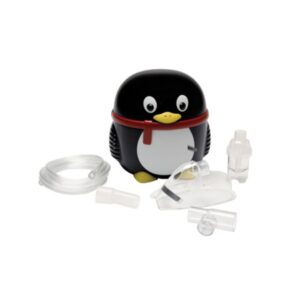
Medquip Airial Penguin Pediatric Compressor Nebulizer System
Medquip
Our Score
Table of Contents
Clinical Summary
Clinical Performance Metrics
Quantitative assessment based on clinical testing protocols
Aerosol Output Quality
Consistently produces a respirable mist with particles ranging from 0.5 to 10 microns, suitable for deep lung deposition.
Ease of Use
Features a simple setup process, one-button interface, and a built-in cup dock that prevents medication spills.
Noise Level
At 55 dB, it is significantly quieter than standard piston compressors, reducing the fear response in infants.
Value for Money
Offers top-tier clinical specifications and a 5-year warranty at an accessible price point for home care.
Quick Take
Key findings from our clinical evaluation
+
Strengths
- Engaging penguin design significantly improves patient cooperation
- Extremely quiet 55 dB operation reduces treatment-related anxiety
- Powerful 42 PSI motor for rapid and effective medication delivery
- Integrated docking station for the nebulizer cup prevents expensive spills
- 5-year limited warranty provides long-term peace of mind
−
Limitations
- Tabletop footprint requires a stable surface and proximity to an AC outlet
- Weight of 3.52 lbs makes it less portable than handheld mesh models
- Mouthpiece provided is standard and not themed like the main unit
Real-World Usage
Practical considerations for daily operation
Daily Routine Impact
The Medquip Penguin integrates into a child's routine as a 'friendly' medical tool, turning a potentially scary medical requirement into a predictable and approachable part of the day.
Learning Curve
Use right out of the box
Maintenance
Standard daily cleaning of the nebulizer cup is required; the air intake filter must be checked monthly and replaced if discolored.
Portability
Low; intended for home use as a stable tabletop station, though it includes a carry bag for car travel.
Manual Use
Provides a consistent, purely manual experience with a large power switch and straightforward tubing connections.
Cost & Coverage Analysis
Financial considerations and HSA / FSA eligibility
Pricing Breakdown
1-Year Total
$197.39
3-Year Total
$472.19
HSA/FSA Guidance
Commonly covered as standard durable medical equipment (DME) for pediatric respiratory diagnoses; use HCPCS code E0570.
Cost Comparison
Priced slightly higher than basic white-box units but offers superior noise reduction and higher air pressure.
Patient Suitability
Clinical indications and contraindications
Indicated For
- • Parents of young children who resist nebulizer treatments
- • Families looking for a quiet, durable primary home machine
- • Pediatric patients sensitive to loud mechanical noises
Contraindications
- • Teenagers or adults who prefer a non-themed clinical design
- • Users needing a silent, battery-powered travel device
Age Considerations
Specifically cleared for pediatric use; suitable for infants and children when used with appropriate aerosol masks.
Clinical Efficacy Assessment
Evidence-based evaluation of clinical performance
Medication Delivery Efficiency
Measures the percentage of medication successfully converted to mist.
High liter flow of 5-8 LPM ensures efficient aerosolization of prescribed dosages with standard residual volume.
Respirable Particle Fraction
The proportion of particles sized for deep lung absorption.
Maintains a particle size output consistent with clinical requirements for lower respiratory tract penetration.
Treatment Time Efficiency
How quickly the device delivers a standard dose.
The 42 PSI motor shaves several minutes off standard sessions compared to weaker 30 PSI pediatric units.
Lung Deposition Rate
The rate at which the medication is absorbed in the lungs.
Consistent operating pressure range of 8-13 PSI supports steady medication delivery during tidal breathing.
Comparative Performance
Ranked #6 of 22 clinically evaluated nebulizers devices
Aura Portable Mesh Nebulizer (Caring Mill)
Aura Medical
PARI eRapid Nebulizer System
PARI
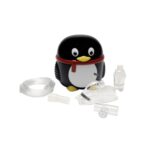
Medquip Airial Penguin Pediatric Compressor Nebulizer System
Medquip
You're viewing this
Medquip Airial Penguin Pediatric Compressor Nebulizer System You're viewing this device
Medquip
Clinical Context
Our #1-ranked nebulizers device demonstrated superior performance across key clinical metrics. Compare detailed specifications to make an evidence-based selection.
Clinical Recommendation
Final assessment and prescribing guidance
The Medquip Penguin is a premier choice for making home respiratory therapy stress-free for children. Its powerful 42 PSI motor and whisper-quiet operation provide a high-value balance of effectiveness and comfort.
Recommend If
You want a reliable, quiet, and kid-friendly home nebulizer that will help your child cooperate during essential treatments.
Avoid If
You require the absolute silence and extreme portability of a handheld vibrating mesh unit.
Clinical Summary
Composite Score
Recommendation
Price Point
Where to Buy
Verified purchase options and current availability
Vitality Medical
Prescription required; Free shipping on orders over $49
Just Nebulizers
Sale price; standard shipping $7.50
Important Information
- • Prices and availability subject to change
- • Some devices may require a prescription
- • HSA / FSA eligibility: Usually Eligible
- • Purchase from authorized retailers for warranty protection