A premier health wearable that bridges the gap between clinical-grade heart monitoring and high-performance athletic endurance.
Garmin Venu 4 Review: The High-Endurance Leader in Cardiac Monitoring
The Garmin Venu 4 represents a significant evolution in the Venu series, firmly establishing Garmin as a medical-grade health monitor for the general consumer. Its cornerstone feature is the FDA-cleared ECG App, which allows users to capture a single-lead (Lead I) ECG by touching the bezel for 30 seconds. Clinical validation in a study of approximately 590 subjects demonstrated that the algorithm correctly identifies AFib 99.5% of the time and maintains 100% specificity for sinus rhythm in classifiable recordings. Beyond spot-checks, the Venu 4 includes an Irregular Heart Rhythm Notification (IHRN) feature that passively monitors pulse intervals via the PPG sensor to detect potential undiagnosed AFib. The device also tracks SpO2, skin temperature variations, and advanced HRV (Heart Rate Variability) metrics through its 'Health Snapshot' feature. With a 3000-nit AMOLED display and a 3nm processor, it offers high-resolution data visualization without sacrificing its industry-leading 12-day battery life. While it lacks the dedicated sleep apnea clearance found in the Samsung Galaxy Watch 8, its integrated 'Body Battery' and 'Training Readiness' scores provide a more holistic view of physical recovery and cardiac strain than most lifestyle-focused wearables.
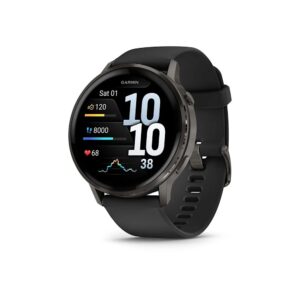
Table of Contents
Clinical Summary
Clinical Performance Metrics
Quantitative assessment based on clinical testing protocols
ECG Accuracy
In clinical trials, the ECG app correctly identified AFib 99.5% of the time, with wave morphology validated as statistically equivalent to standard Lead I ECGs.
Ease of Use
Recording an ECG is straightforward via the bezel contact, though the touchscreen interface can occasionally be sensitive to moisture during workouts.
Health Feature Set
Includes ECG, IHRN, SpO2, respiration tracking, and HRV-based recovery tools, making it one of the most sensor-dense wearables available.
Value for Money
Offers a comprehensive clinical suite without recurring subscription fees, providing high long-term value compared to subscription-heavy competitors.
Quick Take
Key findings from our clinical evaluation
+
Strengths
- Industry-leading battery life (up to 12 days) for continuous monitoring
- FDA-cleared ECG app with proven 99.5% AFib sensitivity
- Works seamlessly with both Android and iOS smartphones
- Multi-band GPS provides professional-grade location tracking for athletes
- No monthly subscription required for full health data access
−
Limitations
- Inconclusive ECG results occur in approximately 11.5% of recordings
- ECG app is not intended for users under the age of 22
- Does not yet feature FDA-cleared sleep apnea notifications
Real-World Usage
Practical considerations for daily operation
Daily Routine Impact
The Venu 4 fits effortlessly into a busy lifestyle; users only need to charge it twice a month while it passively guards their cardiac rhythm 24/7.
Learning Curve
Master in an hour
Maintenance
Periodic cleaning of the sensor window and charging contacts; band replacement every 6-12 months for hygiene.
Portability
Unmatched; the 12-day battery life makes it the best choice for long trips where carrying a charger is inconvenient.
Manual Use
Heart rate and Body Battery are viewable standalone; ECG recordings require the app for historical tracking and PDF exports.
Cost & Coverage Analysis
Financial considerations and HSA / FSA eligibility
Pricing Breakdown
HSA/FSA Guidance
Generally eligible for purchase with HSA or FSA funds as a heart health monitor.
Cost Comparison
More expensive than the Apple Watch Series 10, but more affordable than the Apple Watch Ultra 2 with comparable battery life.
Patient Suitability
Clinical indications and contraindications
Indicated For
- • Active adults who need clinical-grade monitoring with long battery life
- • Android and iOS users who want an agnostic health ecosystem
- • Individuals managing paroxysmal AFib who often forget to charge daily
Contraindications
- • Users with implanted electronic devices like pacemakers
- • Individuals under the age of 22
Age Considerations
ECG and heart alerts are only for users 22 and older; the device is not tested for pediatric use.
Clinical Efficacy Assessment
Evidence-based evaluation of clinical performance
AFib Detection Accuracy
The accuracy of the device in correctly identifying Atrial Fibrillation.
Clinical trial data confirms 99.5% sensitivity for AFib detection in recordings that could be classified.
Heart Rate Monitoring Accuracy
The precision of heart rate tracking during rest and physical activity.
The Gen 5 heart rate sensor shows 96% agreement with clinical reference standards for rhythm interpretation.
SpO2 Measurement Accuracy
How closely blood oxygen readings match medical-grade pulse oximeters.
Validated for spot-checking SpO2; remains reliable for nocturnal hypoxemia tracking, though influenced by wrist strap tension.
Health Alert Reliability
The dependability of automated alerts for irregular rhythms or high/low heart rates.
The IHRN system provides consistent passive monitoring, with abnormal HR alerts triggering after 10 minutes of inactivity to ensure clinical relevance.
Comparative Performance
Ranked #6 of 7 clinically evaluated smartwatches with ecg devices
Apple Watch Series 10
Apple
Samsung Galaxy Watch 8 Classic
Samsung
Garmin Venu 4
Garmin
You're viewing this
Garmin Venu 4 You're viewing this device
Garmin
Clinical Context
Our #1-ranked smartwatches with ecg device demonstrated superior performance across key clinical metrics. Compare detailed specifications to make an evidence-based selection.
Clinical Recommendation
Final assessment and prescribing guidance
The Garmin Venu 4 is a powerhouse of health technology. It is the best choice for anyone who needs reliable cardiac monitoring without the burden of daily charging.
Recommend If
You want the most advanced health tracking available in a watch that doesn't need to be charged every night.
Avoid If
You require a dedicated, FDA-cleared sleep apnea diagnostic or have a very tight budget.
Clinical Summary
Composite Score
Recommendation
Price Point
Where to Buy
Verified purchase options and current availability
Garmin Direct
Official warranty and support; FSA/HSA eligible.
REI
REI Co-op members earn 10% back in rewards.
Amazon
Frequent seasonal price reductions; free shipping.
Important Information
- • Prices and availability subject to change
- • Some devices may require a prescription
- • HSA / FSA eligibility: Usually Eligible
- • Purchase from authorized retailers for warranty protection
Alternative Devices
It provides significantly better battery life than Apple and Samsung, and its ECG accuracy matches the clinical leaders in the field.