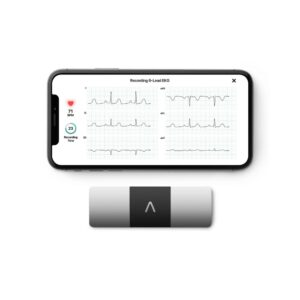
The most portable clinical-grade EKG monitor available, fitting directly into a wallet for on-demand cardiac checks without the need for wires or gels.
AliveCor KardiaMobile Card Review: Clinical-Grade Heart Health in a Wallet-Sized Package
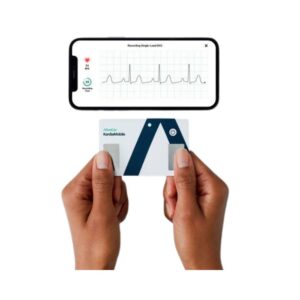
The AliveCor KardiaMobile Card (Model AC-021) is a revolutionary step in personal cardiac monitoring, distilling the technology of a single-lead EKG into a credit-card-sized form factor. The device uses Bluetooth Low Energy to transmit data to the Kardia app, providing users with an 'Instant Analysis' of their heart rhythm. It is specifically designed to detect Atrial Fibrillation, Bradycardia, Tachycardia, and Normal Sinus Rhythm. A standout technical feature is its IPX8 rating, ensuring protection against water immersion for up to an hour. While the device features a non-replaceable battery, its ultra-slim design and clinical validation make it a top-tier choice for those needing reliable rhythm tracking on the go. The system provides professional-grade rhythm strips that can be easily shared with healthcare providers via email or PDF, though a data connection is required for cloud synchronization.
AliveCor KardiaMobile Card
AliveCor
Our Score
Table of Contents
Clinical Summary
Clinical Performance Metrics
Quantitative assessment based on clinical testing protocols
ECG Accuracy
Leverages AliveCor's FDA-cleared KAl platform, delivering high-fidelity waveforms that correlate closely with standard diagnostic Lead I EKG recordings.
Ease of Use
Operation is exceptionally simple: tap the power button and place fingers on the two top-surface electrodes for 30 seconds.
App & Data Quality
The Kardia app provides high-resolution PDF exports and a clear 'History' section for tracking all previous recordings and analysis results.
Value for Money
High value for the portability and clinical clearance, though the non-replaceable battery limits the device's long-term service life to 1-2 years.
Quick Take
Key findings from our clinical evaluation
+
Strengths
- Ultra-slim credit card design fits easily in any standard wallet
- IPX8 waterproof rating allows immersion up to 2 meters for 1 hour
- Instant analysis for AFib, Bradycardia, Tachycardia, and Sinus Rhythm
- Bluetooth connectivity ensures wireless data transfer to mobile devices
- Easy PDF sharing of historical EKG reports with healthcare providers
−
Limitations
- Non-replaceable internal battery limits overall device lifespan
- Single-lead only; lacks the multi-lead depth of clinical machines
- Requires a compatible smartphone or tablet to view or analyze data
Real-World Usage
Practical considerations for daily operation
Daily Routine Impact
This device is designed for seamless integration; it can be carried like a credit card and used whenever symptoms arise, without needing to carry a separate bulky case.
Learning Curve
Use right out of the box
Maintenance
Minimal maintenance; occasional cleaning of the electrodes and ensuring the card is not cut or shredded.
Portability
Unmatched; it is the most travel-friendly clinical-grade EKG on the market.
Manual Use
The device acts as a sensor and data transmitter only; it lacks an onboard screen for viewing EKG results without a smartphone.
Cost & Coverage Analysis
Financial considerations and HSA / FSA eligibility
Pricing Breakdown
1-Year Total
$228.88
3-Year Total
$468.64
HSA/FSA Guidance
Often eligible for FSA/HSA spending; check with individual providers for reimbursement eligibility under remote monitoring codes.
Cost Comparison
Priced competitively for a specialized medical device, offering superior portability compared to standard handheld monitors.
Patient Suitability
Clinical indications and contraindications
Indicated For
- • Patients with paroxysmal arrhythmias needing on-demand checks
- • Frequent travelers who prioritize compact medical gear
- • Health-conscious adults monitoring for early signs of AFib
Contraindications
- • Pediatric patients (device is not intended for pediatric use)
- • Individuals without a compatible smartphone or tablet
Age Considerations
Not tested or intended for pediatric use; designed specifically for the adult population.
Clinical Efficacy Assessment
Evidence-based evaluation of clinical performance
Arrhythmia Detection Accuracy
The ability of the device to correctly identify various heart rhythm abnormalities.
Validated for the detection of Normal Sinus Rhythm, Atrial Fibrillation, Bradycardia, and Tachycardia.
AFib Detection Sensitivity
How reliably the device identifies Atrial Fibrillation when it is present.
Uses proprietary algorithms to identify potential AFib markers with high sensitivity, though users are cautioned to have all results reviewed by a physician.
ECG Signal Quality
The clarity and stability of the ECG trace, minimizing interference and noise.
Provides clear Lead I views; however, signal quality can be degraded by physical activity or nearby electronic equipment.
Clinical-Grade Correlation
The degree to which the device's output correlates with professional hospital equipment.
Meets IEC 60601-1-11:2015 standards for medical electrical equipment used in home healthcare environments.
Comparative Performance
Highest-rated device in Personal ECG Monitors category
AliveCor KardiaMobile Card
AliveCor
AliveCor KardiaMobile Card Current Top Rated
AliveCor
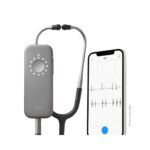
Eko DUO (ECG + Stethoscope)
Eko
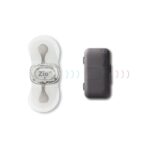
Highest Clinical Rating
This device achieved the highest overall score among 13 clinically evaluated personal ecg monitors devices, demonstrating superior performance across key testing protocols and real-world validation metrics.
Clinical Recommendation
Final assessment and prescribing guidance
The AliveCor KardiaMobile Card is a masterclass in medical miniaturization. It provides the essential tools for rhythm monitoring in a form factor that ensures you are never without clinical-grade heart tracking.
Recommend If
You need a clinical-grade EKG that is always with you and are comfortable with single-lead data for rhythm checks.
Avoid If
You require 6-lead or 12-lead diagnostic depth or do not use a smartphone.
Clinical Summary
Composite Score
Recommendation
Price Point
Where to Buy
Verified purchase options and current availability
Kardia.com
Official store; HSA/FSA eligible.
Amazon
Free shipping and returns; frequently includes bundled offers.
Best Buy
In-store availability varies by location.
Important Information
- • Prices and availability subject to change
- • Some devices may require a prescription
- • HSA / FSA eligibility: Usually Eligible
- • Purchase from authorized retailers for warranty protection
Alternative Devices
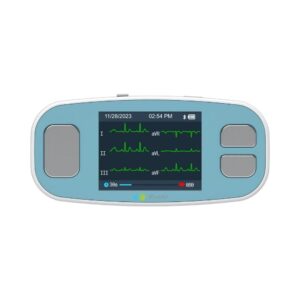
While the KardiaMobile 6L offers more leads, the Card provides far superior portability and water resistance for daily 'in-pocket' carry.