Despite delivering excellent magnetic brushing power, the iO Series 2 is a false economy due to a poorly placed pressure sensor that is completely invisible during use.
Oral-B iO Series 2 Review: Flawed Design Hinders Premium Magnetic Power
Intended by P&G to serve as the absolute entry point into the Oral-B iO magnetic ecosystem, the Series 2 strips the device down to its most basic, rudimentary components. It successfully retains the superior magnetic drive mechanism and the requisite three cleaning modes, ensuring that the actual intraoral brushing power feels identical to higher-tier models costing vastly more. However, severe ergonomic and design flaws severely limit its practical utility. The pressure sensor indicator light is inexplicably integrated directly into the power button on the front face of the handle. Consequently, when the brush is in active use inside the mouth, the user's hand entirely obscures the light, making it virtually impossible to see the pressure warnings in a standard bathroom mirror. Given that slightly more expensive models include highly visible 360-degree light rings specifically to solve this issue, the Series 2 represents a false economy.
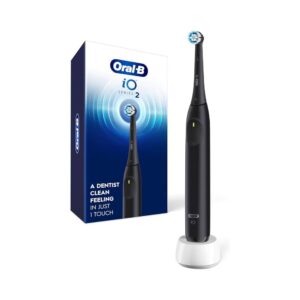
Table of Contents
Clinical Summary
Clinical Performance Metrics
Quantitative assessment based on clinical testing protocols
Accuracy
Provides the exact same elite plaque-disrupting magnetic oscillation as the $300 flagship models.
Ease of Use
A severe ergonomic failure. The user's thumb completely covers the pressure sensor light during standard operation, rendering it practically useless.
Reliability
The magnetic drive is robust and quieter than legacy models, though the battery life is limited to a basic 10 to 14 days.
Value for Money
At roughly $55, it seems like a bargain, but the design flaw and the high cost of replacement heads make it a poor financial decision compared to stepping up slightly to the Series 3.
Quick Take
Key findings from our clinical evaluation
+
Strengths
- Premium magnetic drive system for roughly $55
- Includes 3 essential brushing modes
- Significantly quieter and smoother than legacy mechanical models
- Uses high-quality iO replacement heads
- Excellent raw plaque removal capability
−
Limitations
- Pressure sensor light is completely obscured by the hand during use
- Represents a false economy compared to the iO Series 3
- Short 10 to 14-day battery life
Real-World Usage
Practical considerations for daily operation
Daily Routine Impact
Delivers a dentist-clean feeling but forces you to awkwardly adjust your grip and pause your brushing routine if you want to check if you are applying too much pressure.
Learning Curve
Use right out of the box
Maintenance
Standard handle wipe-downs, frequent charging every two weeks, and purchasing the relatively expensive iO replacement brush heads every 90 days.
Portability
Moderate. The basic battery capacity means you will need to pack the bulky contact charger for any extended vacations.
Manual Use
Frustrating. While the motor is powerful and the modes are easy to toggle via the button, the hidden pressure sensor light negates one of the most important manual brushing aids.
Cost & Coverage Analysis
Financial considerations and HSA / FSA eligibility
Pricing Breakdown
HSA/FSA Guidance
Standard dental insurance does not cover the handle, but consumers can often use flexible spending accounts (FSA) or health savings accounts (HSA).
Cost Comparison
Only slightly cheaper than the vastly superior iO Series 3, making it a poor financial decision in the long run.
Patient Suitability
Clinical indications and contraindications
Indicated For
- • Users strictly bound to a $55 budget who must have the magnetic iO drive
- • Consumers who have perfect brushing technique and do not care about visual pressure warnings
Contraindications
- • Users prone to brushing too hard who critically rely on visible safety sensors
- • Anyone willing to spend a marginally higher amount for a properly designed handle
Age Considerations
Suitable for adults and teens. The handle size and powerful oscillation are typically not recommended for small children.
Clinical Efficacy Assessment
Evidence-based evaluation of clinical performance
Primary Outcome
Measures the percentage reduction in whole-mouth plaque scores over the trial period.
Clinical disclosing tests reveal profound reduction in heavy calculus and plaque, courtesy of the aggressive oscillating-rotating micro-vibrations.
Secondary Outcome
Measures the reduction of gingival inflammation and bleeding on probing.
Clinical improvements in gingival health are hindered by the invisible pressure sensor; test subjects continued to brush too hard because they could not see the warning light.
Comparative Performance
Ranked #20 of 21 clinically evaluated electric toothbrush devices
Oral-B Pro 1000
Oral-B
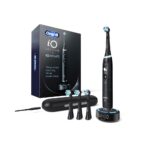
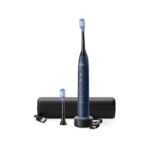
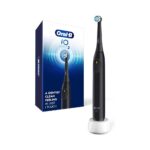
Oral-B iO Series 2
Oral-B
You're viewing this
Oral-B iO Series 2 You're viewing this device
Oral-B
Clinical Context
Our #1-ranked electric toothbrush device demonstrated superior performance across key clinical metrics. Compare detailed specifications to make an evidence-based selection.
Clinical Recommendation
Final assessment and prescribing guidance
The Oral-B iO Series 2 is an unfortunate misstep in industrial design. By placing the critical pressure sensor directly beneath the user's thumb, it renders the safety feature useless, making it a false economy.
Recommend If
You absolutely must have P&G's advanced magnetic drive technology for under $60 and trust your own brushing pressure.
Avoid If
You want to actually see your pressure sensor warnings to protect your gums.
Clinical Summary
Composite Score
Recommendation
Price Point
Where to Buy
Verified purchase options and current availability
Walmart
FSA/HSA eligible.
Target
Available in store and online.
Important Information
- • Prices and availability subject to change
- • Some devices may require a prescription
- • HSA / FSA eligibility: Not Typically Eligible
- • Purchase from authorized retailers for warranty protection
Alternative Devices
It falls drastically behind slightly more expensive options that feature 360-degree light rings, making its only real advantage its rock-bottom entry price for the magnetic ecosystem.