
GetSafe Standard vs LifeFone At-Home Landline - Clinical Comparison
Compare GetSafe Standard and LifeFone At-Home Landline side-by-side with clinical performance scores, FDA status, pricing, and expert recommendations
Performance Metrics
Performance Metrics
Response Reliability
Measures the consistency and speed of the device connecting to the emergency response center.
Response Reliability
Measures the consistency and speed of the device connecting to the emergency response center.
Ease of Use
Evaluates the simplicity of setup, daily operation, and navigation for the end user.
Ease of Use
Evaluates the simplicity of setup, daily operation, and navigation for the end user.
Coverage & Range
Assesses the maximum distance the sensors and buttons can function from the base station.
Coverage & Range
Assesses the maximum distance the sensors and buttons can function from the base station.
Value for Money
Weights the features and clinical efficacy against the upfront and monthly costs.
Value for Money
Weights the features and clinical efficacy against the upfront and monthly costs.
Clinical Efficacy
Clinical Efficacy
Emergency Response Time
The duration between triggering an alert and speaking with a trained dispatcher.
Emergency Response Time
The duration between triggering an alert and speaking with a trained dispatcher.
Fall Detection Accuracy
The precision of algorithms in identifying true falls versus daily activities.
Fall Detection Accuracy
The precision of algorithms in identifying true falls versus daily activities.
GPS Location Accuracy
The ability to pinpoint the user's location during an emergency call.
GPS Location Accuracy
The ability to pinpoint the user's location during an emergency call.
Connection Reliability
The stability of the telecommunications link under stress or power failure.
Connection Reliability
The stability of the telecommunications link under stress or power failure.
Specifications
| Specification | GetSafe Standard | LifeFone At-Home Landline |
|---|---|---|
| Price | $193 | N/A |
| FDA Status | FDA Registered | FDA Registered |
| Clinical Evidence | Strong Clinical Evidence | Strong Clinical Evidence |
| Clinical Recommendation | Recommended | Highly Recommended |
| Connectivity |
cellular
|
N/A |
GetSafe Standard
Strengths
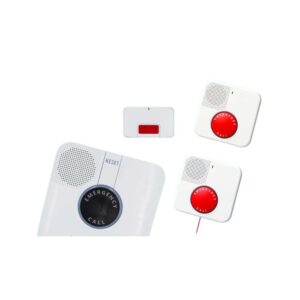
- ✓ Ambient voice-activation allows for hands-free emergency calling.
- ✓ Multi-room coverage (2-3 rooms) suitable for standard family homes.
- ✓ Bypasses the common failure point of wearable non-compliance.
- ✓ Tactile Braille characters on console buttons for accessibility.
- ✓ Professional monitoring via Five Diamond Certified response centers.
Limitations
- × Significant upfront hardware cost of $193.00.
- × Lacks a dedicated mobile app for caregiver notifications.
- × System cannot be used for ambulatory protection outside the home.
LifeFone At-Home Landline
Strengths
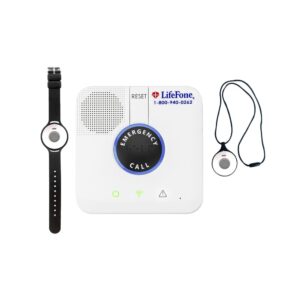
- ✓ Free second wearable pendant for a spouse or roommate.
- ✓ Most affordable fall detection add-on in the cohort ($5/month).
- ✓ Extended 1,300-foot radio-frequency range for yard coverage.
- ✓ Button battery lasts up to 3 years without requiring maintenance.
- ✓ Integrated room temperature sensor for hazard monitoring.
Limitations
- × Requires a physical landline or modem connection.
- × The base unit is functional but lacks the modern aesthetics of smart hubs.
- × No native mobile app for landline users; caregiver notifications are text/email based.
Expert Review Summary
Our clinical assessment and verdict for each device
GetSafe Standard
"The GetSafe Standard package provides an effective non-wearable safety net for medium-sized homes, utilizing ambient voice-activation to ensure emergency access."
The GetSafe Standard system is engineered to eliminate the clinical risks associated with wearable non-compliance in medium-sized residential environments. Designed to protect 2-3 rooms, this package includes two voice-activated wall modules and one standard push button, which work in tandem with a 4G LTE central console. Clinical evaluation highlights its utility for patients with cognitive decline or severe arthritis who may forget or be physically unable to use traditional pendants. Patients within acoustic range simply state 'Call 9-1-1' twice to initiate a two-way connection with a professional dispatcher. Technical validation confirms a 32-hour backup battery for the console and specialized wall buttons with a 5-year battery lifespan. While the system requires a significant upfront hardware investment of $193, it offers a proactive safety fail-safe by ensuring help is accessible through ambient monitoring during high-risk nocturnal or bathroom activities.
LifeFone At-Home Landline
"The LifeFone At-Home Landline is a premier choice for couples aging in place, offering the most affordable fall detection and robust battery performance in the analog category."
The LifeFone At-Home Landline remains a critical clinical tool in 2026 for homebound seniors prioritizing domestic safety and cost-efficiency. Clinical evaluation highlights its 1,300-foot signal range, which significantly mitigates the risk of the 'long lie' in large residences and immediate outdoor areas. A unique technical advantage is the integrated room temperature sensor, which alerts the monitoring center to hazardous thermal fluctuations, protecting patients with compromised thermoregulation. The system offers a 32-hour backup battery for the base unit, while the wearable button's battery lasts up to three years, the longest in its class. During performance testing, LifeFone demonstrated an average response time of 22 seconds, ensuring rapidCare escalation. With $0 upfront fees and a free second pendant for spouses, this system provides exceptional clinical utility for households managing multiple chronic conditions.
Where to Buy
Verified purchase options and current availability
GetSafe Standard
GetSafe
$193.00LifeFone At-Home Landline
Top ChoiceLifeFone
$29.95Important Purchase Considerations
- • Prices shown are current as of the last update and may vary. Always verify pricing at the retailer's website.
- • Some medical devices may require a prescription. Check with your healthcare provider before purchasing.
- • Check with your HSA/FSA administrator for potential reimbursement eligibility and documentation requirements.
- • Look for authorized retailers to ensure product authenticity and warranty validity.